
Phu Dien Communal House
5.0Free
5.0Free
Introduction
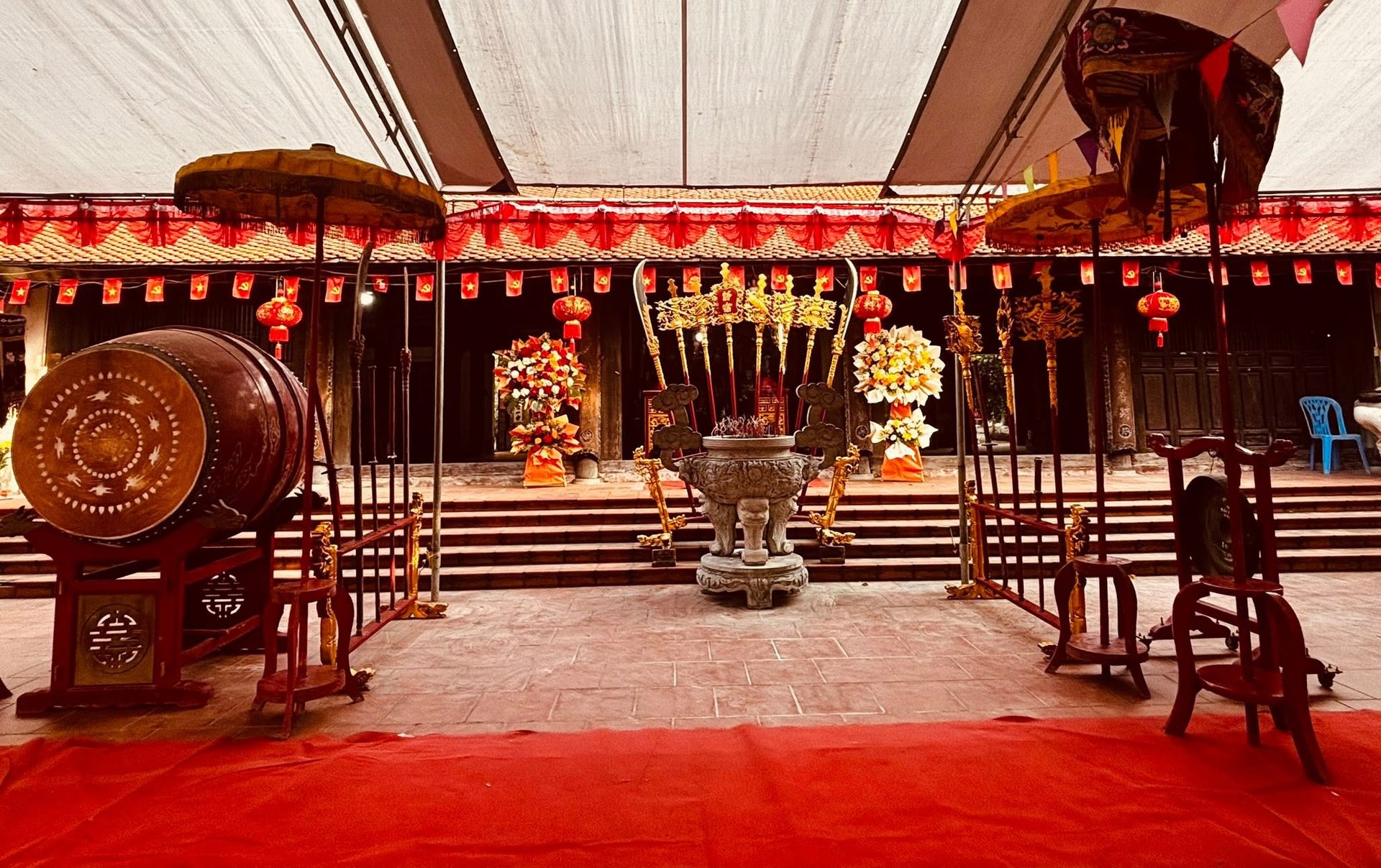
Located in Phu Dien Ward, Hanoi City, Phu Dien Communal House is an ancient communal house with a long history and distinctive artistic architectural value. Depending on the historical period, the land here was once called Phuc Khe (16th century) or Phuc Dien (17th century) before being named Phu Dien from the 18th century to the present.
The ancient village of Phu Dien lies in the main settlement area of ancient Vietnamese residents during the nation-building era; in the past it had the vernacular name Dien Boi, associated with the traditional dragon boat racing festival famous throughout the region.
Phu Dien Communal House was founded in the 17th century – the flourishing period of Vietnamese village communal house architecture – to worship the village tutelary deity who protected the people’s lives. The deity worshipped here is Bach Hac Tam Giang (Tho Linh Dao Truong). According to the deity genealogy Bach Hac Tam Giang Holy King Jade Genealogy (compiled by Dong cac Dai hoc si Nguyen Binh in 1572), he was the third son among five sons of Dao Bot during the reign of the 18th Hung King (Hung Due Vuong). Thanks to his statecraft and high martial skills, Dao Truong was appointed Tho Linh Truong to govern Son Nam district, and later achieved great merit by leading the navy to defeat the northern invaders. He was conferred by the court as Supreme-rank guardian spirit, Tho Linh Thong Quoc Dai Vuong, governing the Bach Hac region and permitting villages to establish shrines for worship.
Every year, Phu Dien village holds four main ceremonial periods on the Saint’s birthday (12th day of the 2nd lunar month), the day of his transformation (10th day of the 6th lunar month), and two thanksgiving days (15th day of the 3rd lunar month and 12th day of the 5th lunar month).
Mentioning Phu Dien village means mentioning two extremely unique intangible cultural features:
· Boat racing festival (Boi thuyen): It takes place in the middle of the 3rd lunar month on the Sach canal (Thu Khe), which flows in front of the communal house. The festival recalls the naval training of Bach Hac Tam Giang during the Hung King era. The race includes 6 dragon boats representing 6 giap; each boat is 12 m long and is controlled by 20 strong young men (including 16 rowers, 1 flag commander, 1 helmsman, 1 poleman, and 1 bailer) amid the urging sound of festival drums. The fame of the boat-racing festival gave the village the affectionate name "Dien Boi".
· Communal House Gate Singing: An age-old form of folk artistic activity. In particular, a stone stele at the communal house records the event that in the 23rd year of Canh Hung (1762), the people of Phu Dien bought outright Communal House Gate Singing script from Thuong Lao commune so they could actively perform it on each village festival occasion.
· Phu Dien Communal House is located on a large plot of land, facing north toward the fields and the old course of the Sach canal. The communal house is planned in the shape of the character Cong, consisting of closely connected main parts:
· Communal house yard and screen: A large square brick yard has a scroll-shaped screen decorated with a statue of a nghe; beside it is a system of ancient stone steles from the Le–Nguyen periods.
· Main Communal House: A five-bay horizontal building, built with gable walls with bít đốc tay ngai, and a roof covered with Vietnamese tiles with wave-shaped ridges. The wooden frame consists of 6 roof trusses linked in the style of chong ruong gia chieng and eave brackets, supported by large cylindrical wooden columns.
· Bridge House: Consists of 2 longitudinal bays connecting the Main Communal House with the Forbidden Chamber; the truss architecture is made in the refined stacked-beam corbel style.
· Forbidden Chamber: Consists of 3 bays and 2 side wings, with panel doors at the front; inside, a high brick platform is built as the place where the village tutelary deity is enthroned and ancient ritual objects are kept.
Sculptural art: Phu Dien Communal House is one of the rare relics that strongly preserves the sculpture of the Le Trung Hung period (17th–18th centuries). On the corbels, eave beams, and side beams of the Bridge House and Forbidden Chamber, ancient artisans carved with great skill subjects such as Nest Dragon, Nine Dragons Competing for a Pearl, Immortals, Warrior Riding a Dragon, along with folk daily-life scenes such as Pouring Wine with Dancers, Bap Benh Game...
The relic currently preserves an extremely rich collection of artifacts in terms of types and materials:
· Imperial Edicts and Deity Genealogy: 15 royal edicts conferring titles on deities from the Le (Canh Hung, Chieu Thong), Tay Son (Quang Trung, Canh Thinh), and Nguyen periods; together with 01 volume of Deity Genealogy compiled by Nguyen Binh in 1572.
· Stone Stele System: 10 ancient stone steles from the Le and Nguyen periods, among which notable is a stele School land record the village's awarding of land to encourage learning.
· Wooden objects and ritual objects: 01 octagonal palanquin (18th–19th century), incense table, kneeling-leg couch, dragon throne and ancestral tablet, ancient Phỗng statue, bronze bagua tray (18th century), bronze bell, white-glazed blue-painted ceramic jar...
Phu Dien Communal House is not only an artistic architectural masterpiece that preserves the essence of folk wood carving from the Le–Nguyen dynasties, but also a place that replenishes and nurtures spiritual life, strengthens community relations in the village, and educates future generations in patriotism and cultural tradition.



