
Phuong Vu Communal House
Introduction
PHUONG VU COMMUNAL HOUSE – A HISTORICAL, CULTURAL AND SPIRITUAL IMPRINT OF THE PHUONG DUC LAND
Located in the rural space of Phuong Vu village, Phuong Duc commune, Hanoi city, Phuong Vu Communal House is one of the typical relics preserving the historical, religious and cultural depth of the local community. The communal house was founded in the Le Trung Hung period, underwent several repairs, and now bears strong Nguyen-era architectural style. In 1993, the relic was ranked at national level by the Ministry of Culture and Information, affirming the special value of the communal house within the local cultural heritage system.
Phuong Vu is an ancient village. According to relic documents, the village was formerly named Phuong Duc, belonging to Phuong Duc canton, Thuong Phuc district, Thuong Tin prefecture. In the Mau Than year 1848, the village name was changed to Phuong Vu. Through historical changes, the name Phuong Vu remains associated with a community rich in cultural tradition, love of learning, and awareness of preserving the heritage of their ancestors.
The deepest value of Phuong Vu Communal House lies in the worship of the three Great Kings who are the village tutelary deities. According to the divine genealogy and handed-down relic documents, the two tutelary deities are Nguyen Ky Great King and Han Vi Great King. The two men are revered by the community as people who helped the country, associated with the resistance against the Yuan-Mongol invaders under the Tran dynasty. The divine genealogy documents say that Nguyen Ky and Han Vi joined the army, fought the enemy together with the soldiers and people, and were recognized by the court for their merits; after their deaths, they were worshipped by the people of Phuong Vu. These stories first of all reflect historical memory and the moral principle of “remembering the source when drinking water,” preserved by generations of local people.
The third tutelary deity worshipped at the communal house is Dong Hai Great King Nguyen Phuc. According to documents introducing the relic, Nguyen Phuc was an official of the Le period who once held the important task of transporting military provisions during the southern campaign under King Le Thanh Tong. After his death, he was deified and worshipped in many localities, including Phuong Vu village. The worship of three tutelary deities shows that the communal house is not merely a place of religious practice but also a community space expressing gratitude to those remembered by folk tradition and local history for their merits to the country and the people.
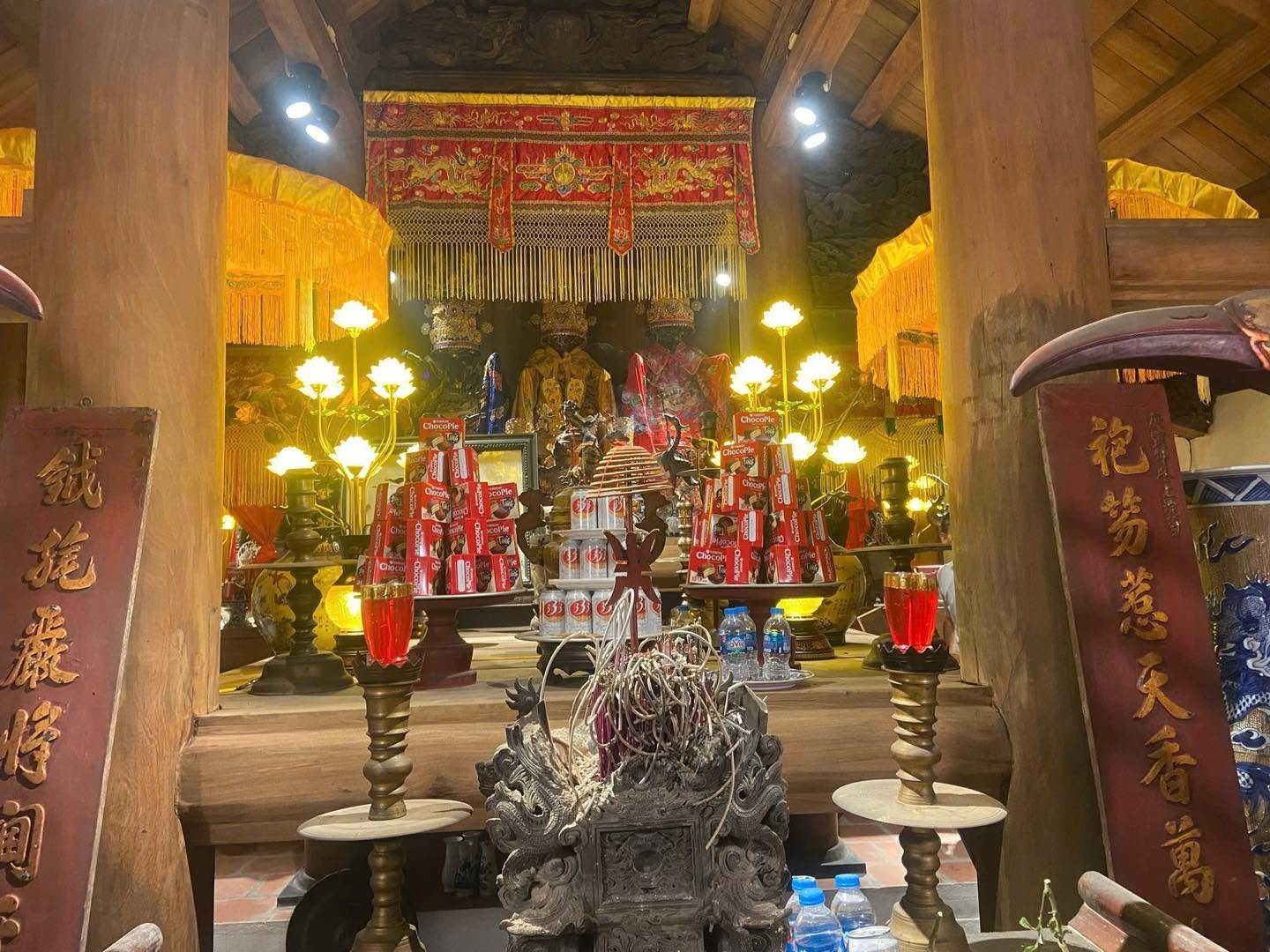
In terms of architecture, Phuong Vu Communal House has a layout in the shape of the character Nhat, with main components including the Bell Tower, Dai Bai and Hau Cung connected in sequence. The Bell Tower was built in the two-story, eight-roof overlapping-eave style; Dai Bai and Hau Cung use many forms of traditional wooden structure. In Hau Cung, three sets of dragon thrones and memorial tablets for worshipping the tutelary deities are arranged. The carved panels, architectural components and altar system form a whole that is both solemn and expressive of the traditional technique and aesthetics of the Vietnamese people.
In particular, the communal house also preserves divine genealogies and 35 royal edicts from various dynasties, which are valuable sources reflecting the history of worship, village institutions, and the recognition by feudal dynasties of the deities worshipped by the community. The value of the communal house therefore lies not only in its tangible architecture but also in the intangible heritage accumulated over generations: rituals, the custom of worshipping tutelary deities, community memory, and the bonds among families and clans in the village.
In recent years, the value of the relic has continued to receive attention for preservation. The project to restore and embellish Phuong Vu Communal House was implemented in the 2024–2025 period; the main components were restored, while a left-side house and right-side house were added, and the yard and Minh Duong well were rearranged. On December 31, 2025, the locality held an inauguration ceremony after restoration, together with incense-offering, palanquin procession, thanksgiving and installation rituals for the tutelary deities. This is not only the restoration of an architectural work but also the continuation of the cultural life of the Phuong Vu community under new conditions.
Phuong Vu Communal House can therefore be seen as a “shared memory of the village”. Each royal edict, each carving, each dragon throne, memorial tablet and each transmitted ritual contributes to telling the story of the land, of those who rendered service to the country, and of generations of residents who together preserved their homeland. For the people of Phuong Vu today, preserving the communal house is not only protecting a national relic but also safeguarding cultural identity, the tradition of solidarity, gratitude, and pride in their homeland.
Visiting Phuong Vu Communal House, tourists not only admire an ancient architectural work but also have the opportunity to learn about a slice of the history of the Northern Delta countryside, where national history, tutelary deity worship and community life converge in a heritage space. It is precisely this depth that creates the enduring value of Phuong Vu Communal House and contributes to the distinctive identity of the people and land of Phuong Duc today.



