1. History of formation and the cult of the village tutelary god
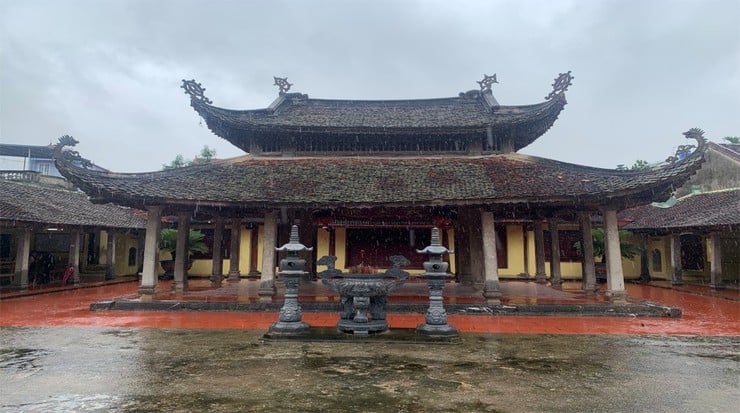
Kênh Đào Communal House in Hồng Sơn commune, Hanoi City, is an ancient architectural work built facing southeast. The house dates from the Later Lê period, around the 17th–18th centuries, and was later restored in the Nguyễn period. Previously, the house had a well and a ceremonial gate. Through the changes of time, war, and transformations in social life, the house has still been preserved and repaired by local people, who regard it as a sacred space tied to the village's origins.
The restoration process during the Nguyễn period, along with repairs in the early 20th century such as in the Duy Tân Mậu Thân year (1908), Duy Tân Tân Hợi year (1911), and Khải Định 5 (1920), contributed to shaping the relatively complete architectural appearance of the house as it is today.
The house worships a tutelary god who secretly aided Lý Thường Kiệt in fighting the Champa and Song invaders in the 11th century. The Lý king bestowed on the god the title “Linh Hiển Đại Vương” (Great Spirit Manifesting King). The cult of the tutelary god at Kênh Đào Communal House reflects the traditional Vietnamese belief in a deity protecting the village community. Through the legend of the god secretly aiding Lý Thường Kiệt against the invaders, the people express faith in the power of righteousness, patriotism, and the aspiration to protect their homeland. Therefore, the house is not only a place of worship but also a spiritual symbol reminding later generations of the nation's tradition of resistance against foreign invasion.
2. Artistic and architectural value of the relic
The overall architecture of Kênh Đào Communal House is organized according to the traditional spatial layout of a Northern Delta village communal house, with the courtyard and worship buildings at the center. The combination of ironwood, stone, old ri tiles, and reliefs of dragons, phoenixes, the four sacred creatures, and stylized flowers and leaves creates a beauty that is both imposing and soft, demonstrating the exquisite craftsmanship of former artisans.
The house consists of main items: the Thiêu Hương (Incense Burning) building, the Đại Bái (Great Worship) hall, the Hậu Cung (Rear Sanctuary), two rows of left and right corridors, pillars, and flower and ornamental plant beds.
The Thiêu Hương building is an architectural item of splendid and imposing beauty. Seen from the outside, the structure is designed in the chồng diêm style, with two tiers and eight roofs, and still retains eight curved roof corners. Dragons are embossed on the roof ridge, and the roof is covered with old ri tiles. Inside, the Thiêu Hương building is tall and airy thanks to the system of columns and open upper walls with ventilation bars. The four main columns are made of ironwood, with carved stone bases in the shape of lotus buds. In particular, the rows of secondary columns on all four sides are made of stone, cut squarely, and the bases and column tops are also made of stone in a single block with the columns. From the main columns to the secondary columns are ironwood braces; the beam ends and surrounding braces are embossed with dragon heads and stylized flowers and leaves.
Inside the Thiêu Hương building, four large cornices remain intact, embossed with scenes of the “four sacred creatures” including dragon, unicorn, turtle, and phoenix, and “four sacred creatures conveying the bowl” — a fusion of yin-yang theory in ancient thought. The precious animals are exquisitely carved: dragons winding in clouds, phoenixes spreading their wings, carp plunging into “rippling water waves.” Some cornice panels are carved with long hóa (dragon transformation), that is, the four seasons transformed into dragons. The Han characters on the roof indicate that this architectural item was built in the Khải Định 5 year (1920).
The Đại Bái hall consists of five bays and two side wings. Its architectural structure follows the four-row-of-columns form. The two main roof trusses have the structure “giá chiêng rường cụt, bảy hiên”; the four side trusses have the structure of upper giá chiêng rường cụt, lower kẻ, and bẩy hiên. The Đại Bái hall was substantially restored to its current scale in the Duy Tân Mậu Thân year (1908). Overall, the Đại Bái hall is beautiful in its imposing, spacious, and solid appearance. If the Thiêu Hương building impresses with its splendor and upward reach, the Đại Bái hall has a balanced, warm appearance created by its interior.
The interior space of Kênh Đào Communal House brings together traditional decoration with horizontal lacquered boards, parallel sentences, and ritual objects splendidly lacquered in red and gilded. In terms of carving, unlike the communal houses in the surrounding area, the cornice panels here are formed by a system of overlapping braces. Three beams and the beam ends form the cornice; on these beams, dragon and leaf motifs are embossed very flexibly. The beam ends carry the artistic style of the Nguyễn period with dragons with flared mouths, holding pearls, and rather long whiskers and hair. Inside the Đại Bái hall in the central bay, the part adjoining the Hậu Cung, the cornice panels, beams, and corner braces are coated in red lacquer, creating warmth and increasing solemnity.
The Hậu Cung of Kênh Đào Communal House was built attached to the Đại Bái hall, in the “chuôi vồ” style, also called the “chữ đinh” style. In front of the Hậu Cung door is the Trung Cung. Here are arranged large characters “Xuyên Phương Chí,” “Thượng Đẳng Từ,” scroll boards, and reliefs of Han-character poems praising the merits of the worshipped god and the beauty of the village communal house. The Hậu Cung is the oldest architectural item of the house. It still preserves a number of Lê-period artifacts from the 17th–18th centuries, such as the curtain gate and two cornice panels above the Hậu Cung entrance. These are cornice panels carved with the “Mother and Child Dragon” scene very exquisitely, carefully lacquered in red and gilded. Inside the Hậu Cung are arranged a dragon throne, memorial tablets, a box of royal edicts, and a number of precious artifacts.
The two rows of left and right corridors are two five-bay buildings, with a structure of giá chiêng quá giang, plain planing and decoration tending toward durability. Both roofs are covered with old ri tiles, small and thin, with the ridge part thicker. The construction date of the left and right corridors is the Duy Tân Tân Hợi year (1911).
The architectural items of the house are distributed harmoniously, serving both worship rituals and community activities. The Thiêu Hương building creates an accent of splendor and height; the Đại Bái hall is the space for receiving the community during rituals; the Hậu Cung is the most sacred place, preserving the dragon throne, memorial tablets, and worship artifacts; the two rows of left and right corridors contribute to completing the layout, creating a balanced and solemn appearance for the entire relic.
3. System of precious artifacts at the relic
Kênh Đào Communal House still preserves many valuable artifacts, including a copy of a genealogy of deities in Han characters from the Bảo Đại sixth year (1931), 12 royal edicts from feudal dynasties conferring titles on the village tutelary god, and many other valuable artifacts.
The system of genealogies of deities, royal edicts, horizontal lacquered boards, parallel sentences, ritual objects, and decorative carvings is a valuable source of material for researching the history of Kênh Đào village, traditional architectural art, and the Vietnamese cult of the tutelary god. These artifacts help clarify the formation and development of the relic and affirm the house's position in local cultural life.
4. Traditional festival of Kênh Đào Communal House
The Kênh Đào Communal House festival has existed since ancient times. According to village elders, in 1958 the elders of Kinh Đào village wrote a petition to organize a village festival, including a procession. With the approval of the former Mỹ Đức District People's Committee, all the people of Kinh Đào joyfully held the festival for three days, the 11th, 12th, and 13th of the 11th lunar month of the Mậu Tuất year. The following year, the festival was not held, but on this occasion the people still performed the ceremony of worshipping the god. In 1994, the village's traditional festival was restored according to the convention “tam niên nhất lệ” — held once every three years.
The main festival takes place from the 11th to the 13th of the 2nd lunar month, with the main festival day being the 12th of the 2nd lunar month. The customary festival is held in the seasons: spring on the 11th and 12th of the 2nd month; summer on the 11th and 12th of the 5th month; autumn on the 11th and 12th of the 8th month; winter on the 11th and 12th of the 11th month.
During the festival, in addition to the ritual part with ceremonies of incense offering, worship of the tutelary god, procession, and praying for blessings, the festive part is an occasion for people to exchange, recall traditions, and strengthen neighborly ties. The religious activities at the house express gratitude to predecessors and pray for national peace, favorable harvests, and a warm and happy life.
The Kinh Đào village festival is held to commemorate the merits of the village tutelary god, whose title is Thanh Hải, courtesy name Thành hoàng Chiếu Pháp “Linh Hiển Đại Vương.” The genealogy of deities states that in the Lý period, the Song court colluded with the Champa invaders to attack our country. The enemy had up to 500,000 troops and thousands of war horses, divided into five routes to invade Đại Việt. The Lý king summoned Lý Thường Kiệt, appointed him as vanguard commander, commanding general, and overall commander of the entire army preparing for battle.
Lý Thường Kiệt and 500 warriors set off urgently. Passing through Thiên Sơn cave, traveling another two days and nights to Chương Đức district, now Chương Mỹ, then to Chiêm Bái to visit the Ngô family ancestral tomb. After that, he led his troops to the mountain edge and stationed them at an ancient shrine of Kênh Đào hamlet, now Kênh Đào village. One night while sleeping in the shrine, Lý Thường Kiệt was told in a dream by a divine person. He saw a god with a tall, majestic figure, claiming to be of the Hùng Vương lineage and the tutelary god governing this land. The god said that seeing the general leading troops against the enemy and sincerely praying, he would help. That day was the 11th of the 2nd month.
The next day, Lý Thường Kiệt met the people of Kênh Đào hamlet. He left the people some money and gold to repair the shrine and maintain incense and lamps, then continued his journey. After battles under Lý Thường Kiệt's command, both the Song army and the Champa army were defeated. Our troops pursued the enemy to Quảng Nguyên prefecture, killing many enemy generals and soldiers.
Peace reigned under heaven. On a auspicious day, Lý Thường Kiệt submitted a petition to the king, stating that the victory over the enemy was also due to the secret aid of the tutelary god of Kinh Đào village. The Lý king bestowed on the god the title “Linh Hiển Đại Vương,” granted the title “Hộ Quốc,” and added the beautiful title “Nhâm Minh Thịnh Đức, Dương Ứng Yên Công, Bố Trạch Trạc Linh Đại Vương, Thượng Đẳng Thần,” and approved that Kinh Đào village worship him. Later, according to the genealogy, the god also helped the Trần dynasty fight the Yuan-Mongol invaders and the Lê dynasty fight the Ming invaders, and was conferred many other beautiful titles by successive dynasties.
The traditional festival of Kinh Đào village is a source of pride for local people whether they live in the homeland or far away. Organizing the village festival is an occasion for everyone to remember their roots and show respect for ancestors and national heroes. Through the festival, people come closer together, demonstrating solidarity and attachment within and beyond the village. Younger generations have the opportunity to imbibe the spirit of patriotism and love for the homeland.
5. Cultural-historical value and role in community life
Kênh Đào Communal House has outstanding historical value because the relic is associated with the legend of the village tutelary god secretly aiding national heroes in the cause of defending the country. Although that story has the color of folk belief, it contains patriotism, the will to resist foreign invasion, and pride in the homeland's traditions.
In terms of artistic and architectural value, the house is a typical testament to traditional construction techniques and carving art. The roof trusses, cornice panels, beam ends, braces, curtain gates, and the system of ironwood and stone columns show the sophistication in design, material selection, and decoration. In particular, themes of the four sacred creatures, mother and child dragons, and four seasons transformed into dragons not only beautify the worship space but also reflect aesthetic concepts, yin-yang philosophy, and the community's aspiration for fertility and sustainability.
In present-day life, Kênh Đào Communal House continues to play the role of a center for cultural and religious activities of local people. On each festival occasion, lunar first and fifteenth days, the tutelary god's death anniversary, or village cultural events, the house becomes a meeting place for generations and a space for people to turn toward their roots, educate their children about the moral principle of remembering the source when drinking water, national pride, and responsibility for protecting heritage.
Preserving and promoting the value of Kênh Đào Communal House has practical significance in maintaining national identity. The relic is not only an ancient architectural work but also a place preserving community memory, customs, rituals, beliefs, and the cultural lifestyle of Vietnamese villages. Protecting Kênh Đào Communal House means protecting a part of the homeland's soul, contributing to enriching the cultural heritage treasure of the capital and the country.
From the above values, it can be affirmed that Kênh Đào Communal House is the pride of local people, a valuable address for traditional education for younger generations, and an important highlight in preserving and promoting national cultural identity in the context of modernization and integration today.




