
Tao Khe Communal House
Introduction
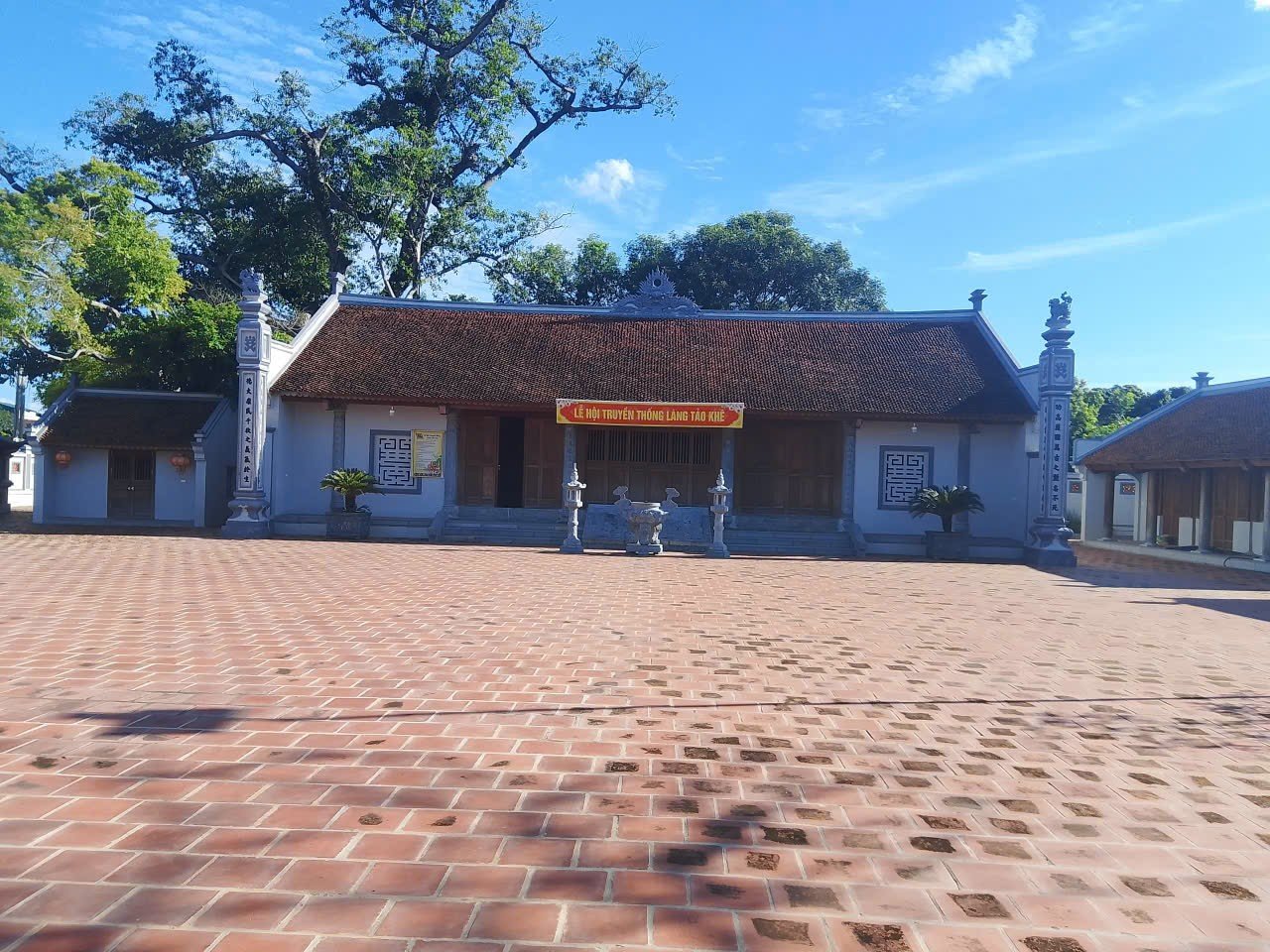
Tảo Khê Communal House, Kinh Đào Tảo Khê village, Hồng Sơn commune, Hanoi city
Tảo Khê Communal House worships the Supreme Deity; the communal house currently preserves 13 royal edicts. It was ranked as a national historical and cultural relic in 1998 by the Ministry of Culture and Information under Decision No. 1811/QĐ-BVHTT dated August 31, 1998.
According to the Ngọc phả (jade genealogy) written about the national-protecting great king Long Thần, who appeared during the reign of Hùng Duệ Vương—the Thành hoàng worshipped at Tảo Khê Communal House. The thần tích (deity legend), now archived at the Institute of Hán-Nôm Studies (Vietnam Social Science Committee), has the code AE a2/75. Based on translated documents, the parallel sentences and horizontal inscriptions at Tảo Khê Communal House, and accounts from elderly people knowledgeable about cultural traditions and good customs, the legend of the figure worshipped at Tảo Khê Communal House is as follows: Tảo Khê Communal House worships Ngô Long, a general under Hùng Duệ Vương. His father was Ngô Huy Tín. His mother was Nguyên Nương. The Ngô family was wealthy and treated people's illnesses, so everyone respected them.
Tảo Khê is a village along the Đáy River; its water surface serves as a mirror reflecting bamboo groves, elegant roofs, and the ancient moss-covered communal house roof weathered by time. The village was named Kẻ Trai, then Trang Văn Trai, and only later in the Nguyễn era received the literary name Tảo Khê; today it is Kinh Đào Tảo Khê village. Thus it also reflects a place name of a traditional Vietnamese village. Located additionally on the Đáy River, with the Thung Thiên mountain range and Quan Sơn lake far to the west. This unique cultural setting gives Tảo Khê a very Vietnamese identity—from the Hùng Vương period to the present. One of the many fine traditional cultural features is the village communal house—material culture. The communal house is an architectural and artistic work in which many spiritual cultural activities of the community take place. These essences are reflected in the wood-carved artworks in the communal house.
Tảo Khê Communal House enjoys an open space and clean environment; a more than 300-year-old banyan tree remains green, its branches and leaves spreading over the communal house roof, and bamboo provides shade for people coming to the village cultural center.
The communal house is located in a scenic compound—an architectural work in the shape of the letter đinh (J). Outside is the đại bái (main worship hall), inside is the hậu cung (rear sanctuary). This architectural work is surrounded by brick walls, with closed gable walls, straight roof ridges and gable edges. Two independent sloping roofs are covered with ri tiles. The đại bái is a large architectural work with five bays. The central bay is the widest, and the side bays are symmetrical. From the courtyard, there are three steps, plus a door made of box-shaped stone slabs. The central stone slab is carved with a motif of two dragons facing the moon. The side stone slabs are decorated with seal-script motifs.
The wooden structure of the đại bái consists of four rows of round stone columns, with lotus-petal-carved base blocks. The column shafts have a single dragon winding around from the top down in many coils, then raising its head as if soaring in the clouds. There are fourteen stone columns about 35 cm in diameter and twelve box-shaped stone crossbeams, polished and incised, with roof trusses in the form of a chống giường con nhị placed on the câu đầu. The ends of the short rường are carved with leaf motifs. The front and rear trusses are panels carved in relief and openwork with motifs based on stories: carp going to take an oath, long quấn thủy (dragon coiling in water), and the four sacred creatures (dragon, qilin, turtle, phoenix) for the four seasons spring, summer, autumn, winter. Each season has a precious tree. Trees transforming into dragons include bamboo transforming into a dragon and từng transforming into a dragon. The craftsmen carved skillfully so that the trunk becomes the dragon's body, the root the dragon's head, the leaf tips the tail, and the dragon's mane is both whimsical and beautiful, illogical yet logical. It reflects the intelligence and creative talent, rich imagination of the folk cultural soul of the Vietnamese people in the wet-rice agricultural community.
In the hậu cung, where the Thành hoàng's throne is placed, it is solemn, so there are few wood carvings. The truss set is simple with rafters on the roof truss and a mê cốn panel forming a tiger symbol, representing authority—divine power and strength. Along with ritual weapons such as the Eight Treasures, xà mâu, long swords, spears and halberds—weapons of our ancestors used to fight invaders and defend the country—are arranged beside the altar of the Thành hoàng. All these architectural features and arrangements make the place of worship solemn.Tảo Khê Communal House currently preserves many precious artifacts, such as a procession palanquin, a set of the Thành hoàng's throne, ritual objects, and a pair of cracked-glaze lục bình vases.
The communal house was recently restored and renovated and handed over for use at the end of 2025.
The festival has been held since the 18th century; today it is held once every three years and lasts three days: the main festival is from the 9th, 10th, and 11th days of the second lunar month, with offerings and palanquin processions. In addition, every year villagers also hold ceremonies on occasions such as the 10th day of the eighth lunar month and the 10th day of the eleventh lunar month, commemorating the saints.



