
Thach Cau Communal House
Good to know
- You should arrive early for an open and airy experience
- Free
- Convenient access by taxi or bus.
Introduction
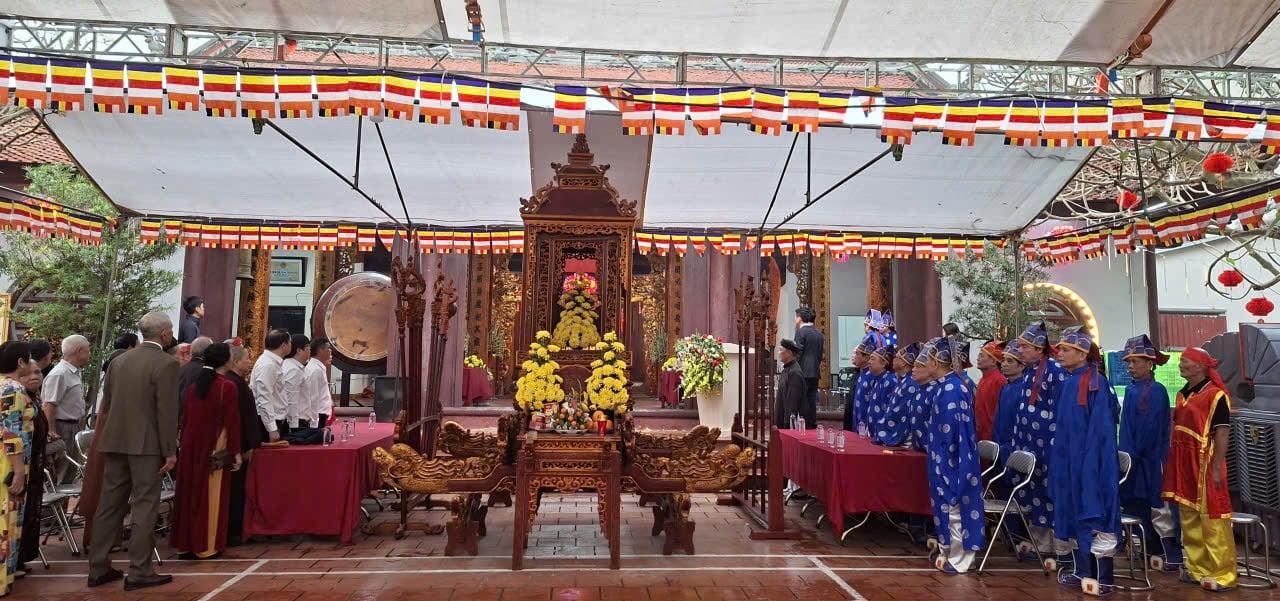
The Thach Cau Communal House – Pagoda relic complex formerly belonged to Thach Cau Hamlet, Chi Minh Commune, Gia Thuy Canton, Thuan An Prefecture, Kinh Bac Garrison. In the Nguyen period it was in Bac Ninh Province. At the end of 1947, Co Linh Commune was renamed Phi Truong Commune. At the beginning of 1949, Bac Ninh Province merged Thach Cau Hamlet and Lam Du Hamlet of Chi Minh Commune into Phi Truong Commune and renamed it Long Bien Commune.
The Thach Cau Communal House relic currently belongs to Thach Cau 1 and 2 residential groups, Long Bien Ward, Hanoi City. The relic lies on the bank of the Red River, about 2.5 km from the center of Hanoi; after crossing Chuong Duong Bridge about 2 km along the Long Bien–Bat Trang dike road, we see a dike gate at the beginning of Thach Cau Street alley; go about 300 m, turn into alley 56 about 350 m, and we see immediately the Thach Cau Communal House relic complex situated on a high plot of land facing south. Before us is an ancient communal house structured in the Tam-character style, including a five-bay Dai Bai, a Trung Dinh, and a three-bay Hau Cung, structured in the upper chong giuong gia chieng and lower ke styles; in front is the communal house yard, well, and nghi mon; to the left of the communal house are the storehouse and kitchen area.
When did Thach Cau Communal House originate? Current documents kept at the communal house do not show the date of its initial construction; according to elderly villagers, Thach Cau Communal House was initially built at the beginning of the Nguyen dynasty and was very large; in 1923, a great flood caused the entire frame and architectural structure of the communal house to drift away, leaving only stone column bases 0.5–0.6 m in diameter. In 1987, local people restored and rebuilt the communal house as spacious as it is today.
Thach Cau Communal House and the deities and village tutelary gods are worshipped here; it is dedicated to two generals who assisted Saint Tan Vien: Cao Son and Quy Minh, twin brothers from the reign of the 18th Hung King, born into a family that observed rites, was well educated, and possessed unrivaled martial skills. When the two were two years old, both parents died. At that time, King Hung Due Vuong issued an edict to the provinces, districts, and circuits to select talented and virtuous people to serve as officials and lead troops to suppress foreign invaders. Seeing this, the two asked to return to court to apply. The king saw that they had exceptional literary and martial talents and selected them, ordering them to hold the position of commanding envoy. Although they received the king's grace, they did not forget their parents—funeral rites and worship were conducted carefully and sincerely. It is said that King Hung had four children (two sons and two daughters). But afterward both sons died young, and when the two daughters reached adulthood, Hung Due Vuong married one to Chu Dong Tu and one to a general surnamed Nguyen named Tung, and passed the throne to him. At the same time, in Ai Lao land there was a man surnamed Thuc named Phan, originally of the Hung lineage; after branching off, he came to rule this land and changed his surname. Hearing that Hung Due Vuong had passed the throne to his son-in-law, Thuc Phan became jealous and led troops to invade. Hung Due Vuong was worried and summoned Son Thanh to court; Cao Son and Quy Minh came to receive orders and were appointed left and right generals, vanguard, and set out to defeat the Thuc enemy in the Northeast. Cao Son and Quy Minh obeyed and set out, with drums and flags covering the sky. When they reached the Northeast, the Bac Giang route, it was already dusk, so they made camp and stationed troops there. Seeing that this land had many advantages for military affairs, they ordered soldiers and people to establish ramparts and forts to fight the enemy. One day, while sleeping in the headquarters, both dreamed that local spirits came to ask to assist them. In the morning they performed ceremonies and rewarded the soldiers. Villagers enthusiastically responded and helped. Cao Son and Quy Minh told the elders of the area: We obey the Son of Heaven to help the country and pacify the people, bringing troops here to establish forts and defenses to fight the enemy, and we have been helped by the people and supported by the local god; therefore we give gold and silver so that the people of the area may build a shrine for worship forever after. Indeed, afterward the two defeated the Thuc invaders, and from then on the world was peaceful and the country had no trouble. Son Thanh submitted a memorial to the king saying: Now that Thuc has been pacified, the king should summon the two famous generals Cao Son and Quy Minh and other officers and soldiers to court to hold a banquet, reward them, and confer titles on those with great merits. The two obeyed and returned to court, and also reported to the king: We obeyed Your Majesty's order to lead troops to the Northeast, the Bac Giang route, to guard the forts to defeat the enemy; with divine support and the response of the local people, we won and returned, and now we ask to repay them. The king heard this and approved. The two thanked him and returned to the place where they had previously stationed troops and established forts. Here, the elders and villagers came to congratulate them, and the elders reported: Since the two of you stationed troops here, the villagers have had peaceful livelihoods and become more prosperous and healthy day by day. The people ask that on this land—formerly a garrison and later a shrine for worship in remembrance—we may build. The two agreed and told the elders of the village: The people of the area have shown us respect that will be passed down for ten thousand generations, but when building the shrine for worship, let the local guardian spirit share in the worship. The two gave the people of the area gold and silver to later expand the shrine and ponds and fields to support worship. At the same time, two golden clouds descended to the place of the two; this was also their transformation on the 15th day of the 3rd lunar month. The people of the area made a petition to the king. The royal court ordered the people of the area to perform sacrifices to the two and also conferred titles on the two: Cao Son and Quy Minh were conferred the title of Superior Grade Blessed Deity. Thach Cau Communal House and a number of communal houses in the Northeast are dedicated to them.
Thach Cau Communal House Festival and folk games: The Thach Cau Communal House Festival is usually held on the 9th and 10th days of the 2nd lunar month every year. Coming to the traditional Thach Cau Communal House Festival, in addition to the ritual procedures of the officials' offerings and ceremonies held in the communal house, we can also enjoy folk songs and quan ho melodies of the elder brothers and sisters, and the vi and xoan songs of the women and girls during the welcoming and offering rituals of groups, clans, guests, and pilgrims from all directions making offerings at the communal house; distinctive sports activities and folk games have been restored such as cockfighting, Chinese chess, tug-of-war... In particular, the game of surrounding and catching Mr. Manh Tiger is organized; every year the festival organizing committee selects among village households good at livestock raising to choose a large, strong pig to bring to the festival for the surrounding and catching; members of the clan who wrestle Mr. Manh Tiger down receive a portion of the pork after slaughter, and the head is offered at the communal house. This is a form that embodies the solidarity and strength of our army and people, as well as reenacting the surrounding attacks of the two generals who assisted Saint Tan Vien to help King Hung Due Vuong protect the country and bring national prosperity and peace for the people.
In 2012, the Hanoi City People's Committee issued Decision No. 5593/QD-UBND dated December 4, 2012, on attaching a plaque marking the revolutionary resistance event site at Thach Cau Pagoda, Long Bien Ward.
More Other places
- Other placesVerified
Gioi Duc Pagoda (Hong An Temple)
Ung Hoa Commune
5.0Free  Other placesVerified
Hai Giac Pagoda
O Dien Commune
5.0Free Other placesVerified
Phuong Bang Pagoda (Hung Long)
Son Dong Commune
5.0Free Other placesVerified
Sung An Pagoda, also known as Sung Khang Pagoda (Dong Ba Pagoda)
Thượng Cát Ward
5.0Free
