
Thị Cấm Communal House
Introduction
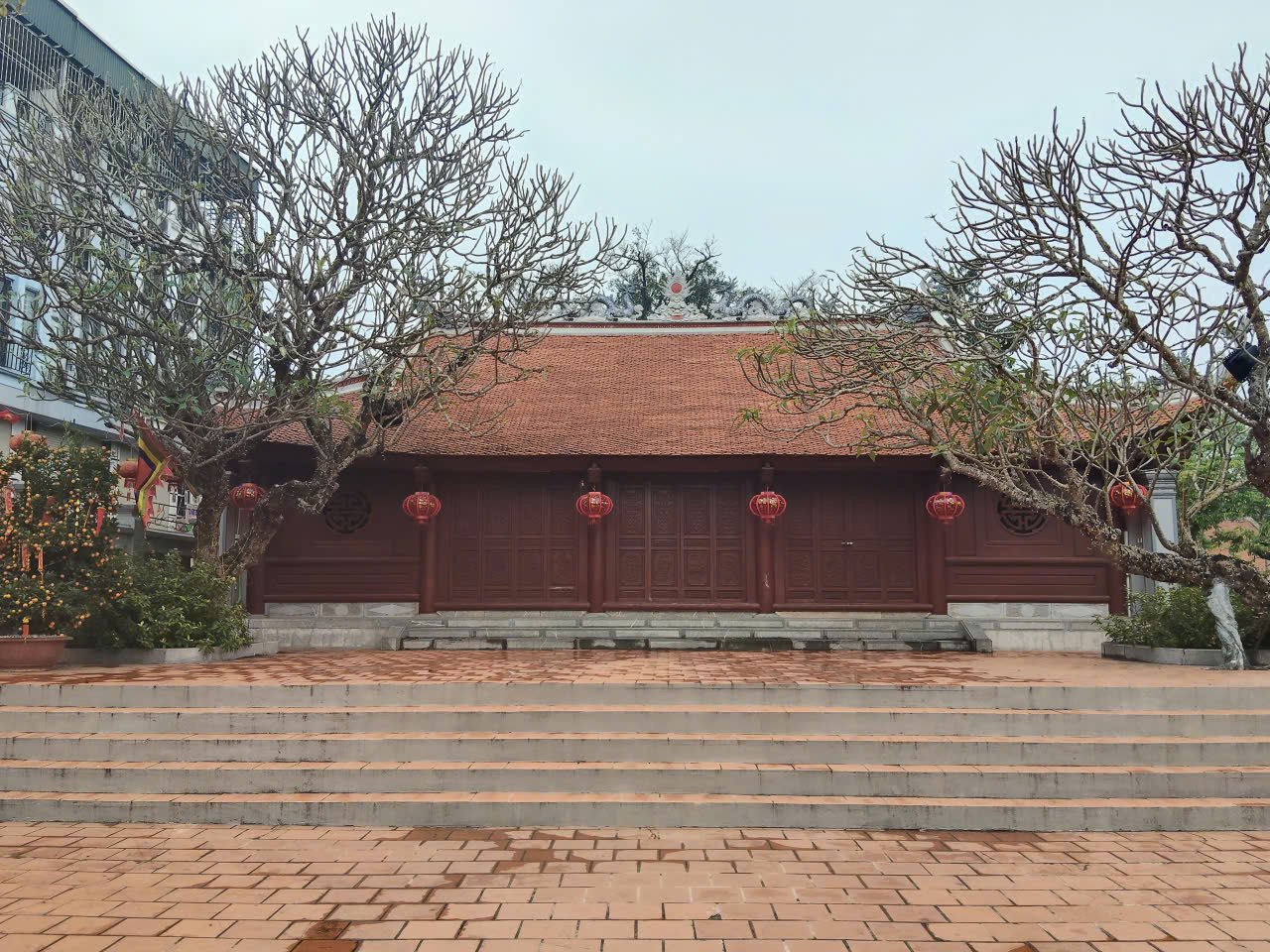
Thị Cấm Communal House is the ancient communal house of Thị Cấm village, now in Xuân Phương ward, Hanoi. Previously, the relic belonged to Thị Cấm hamlet, Xuân Phương commune, Từ Liêm district. This is an ancient village of the former Phương Canh area, where historical, religious, and traditional custom traces remain quite dense.
The communal house was built on a flat plot adjacent to the village residential area and faces east. The current architectural complex includes the Tam quan (three-entrance gate), communal courtyard, Đại bái (main worship hall), Phương đình (square pavilion), Trung cung (central sanctuary), and Hậu cung (rear sanctuary). The architectural layers follow one another on the same axis, moving from the open space for the community gradually into the solemn worship area inside.
Đại bái is the largest architectural section, consisting of five bays. It is both the place where sacrificial ceremonies take place and a space for meetings and community activities. Behind Đại bái is the square-plan Phương đình, which serves as a transitional space before going deeper into Trung cung and Hậu cung.
The inner part of the communal house is organized in a 'chuôi vồ' (mallet-handle) plan. Hậu cung consists of two bays, where the long ngai (throne), the tablet of the Tutelary God, and the jointly worshipped deities are placed. Over many centuries, the communal house has been restored several times, so its current appearance is the result of successive architectural layers.
The value of Thị Cấm Communal House also lies in its system of artifacts. Most notable are the edicts conferred on Phan Tây Nhạc Đại Vương and the jointly worshipped goddesses. Hán Nôm documents currently record many edicts spanning the reign eras of Vĩnh Thịnh, Vĩnh Khánh, Cảnh Hưng, Chiêu Thống, Quang Trung, and Cảnh Thịnh. Among them, the early 18th-century edicts are the earliest artifacts helping to establish that the communal house existed at least from this period.
In addition, the communal house also has a stone stele dated to the first year of Cảnh Hưng, 1740; the long ngai, tablets, and many ritual objects. A very special group of artifacts are the utensils used in the Rice-Cooking Contest Festival, such as bronze pots, stone mortars, pestles, water-drawing vessels, and fire-making tools. These objects are still used in the festival, so they are both artifacts and part of a living heritage practice.
On 2 March 1990, Thị Cấm Communal House was ranked by the Ministry of Culture and Information National-level historical-cultural relic.
By 2021, the Thị Cấm Rice-Cooking Contest Festival continued to be inscribed as National intangible cultural heritage. Therefore, Thị Cấm Communal House is a special place where both tangible and intangible heritage coexist, complement each other, and continue to be preserved by the community in present-day life.
The main deity worshipped at Thị Cấm Communal House is Phan Tay Nhac Dai Vuong, a god associated with the legend system of the Hùng Duệ Vương era.
According to local hagiography, Phan Tây Nhạc was from Hà Trung, Châu Ái, in present-day Thanh Hóa. He is described as a man of extraordinary strength, proficient in letters and martial arts, and skilled in organizing troops.
When war broke out in the country, Phan Tây Nhạc followed and assisted the court and was assigned to join Tản Viên Sơn Thánh in suppressing rebellion. Thanks to his talent for training troops and organizing military provisions, he achieved many merits and was trusted by the king.
The hagiography also tells that he was granted three princesses as wives. The three women were not only his spouses but also helped him manage military provisions, guard the camp, and support the fighting.
After the country was peaceful, Phan Tây Nhạc and his wives returned to the Phương Canh area. Seeing that the land here was fertile and the people gentle, he asked to establish a temporary palace and stay. In the memory of Thị Cấm people, he is also remembered as the one who guided the people in farming, mulberry cultivation, and weaving, helping turn wasteland into a prosperous settlement.
It is precisely the story of Phan Tây Nhạc's ability to organize military logistics that has become the basis for explaining the Thị Cấm Rice-Cooking Contest Festival. People believe that today's contest of drawing water, making fire, and cooking rice reenacts the selection of people skilled in serving military provisions in the past.
Those details belong to the realm of hagiography and folk legend, but their value lies in how the community constructs the image of the Tutelary God: a general who served the country, was skilled in organizing soldiers, and also cared for the people's lives.
Therefore, in the minds of Thị Cấm people, Phan Tây Nhạc is not only a worshipped figure but also a symbol of loyalty, strength, skill, and community solidarity.
The most distinctive feature of the festival associated with Thị Cấm Communal House is the Rice-Cooking Contest Festival, held on the 8th day of the first lunar month every year.
According to legend, when Phan Tây Nhạc was preparing to lead his troops into battle, he needed to select people capable of handling logistics very quickly. From this arose the contest of drawing water, making fire, and cooking rice in a short time. The people of Thị Cấm later reenacted that story as a community ritual.
On the morning of the festival, after the incense offering to the Tutelary God, four teams representing the four giáp enter the contest.
First is the water-drawing contest. Contestants must quickly run to the well, draw water with the prepared tools, and bring it back to the communal courtyard.
Next is fire-making contest. Without using matches or lighters, contestants use dry bamboo and giang sticks to rub together, create heat, and ignite tinder and straw. This is one of the most difficult and also most attractive parts of the competition.
At the same time, other members must pound paddy into rice, quickly winnow it, then put it into a pot to cook using the very water and flame just created.
When the rice is nearly cooked, teams often try to retain heat and finish the pot of rice under limited time conditions. Then, the rice is brought to the communal house to offer to the village tutelary god and for judging. An important criterion is that the rice must be white, sticky, fragrant, and evenly cooked.
The special point of the festival is not which team wins. More important is that the whole community together reenacts a story passed down through many generations. The sound of pestles pounding paddy, straw smoke, and cheers around the communal-house yard make the legend of Phan Tây Nhạc a vivid experience.
Besides the January festival, Thị Cấm also has a ceremony to worship the village tutelary god in the second lunar month, associated with the friendly relations with Hòe Thị village. Both villages worship Phan Tây Nhạc, so they have the custom of carrying the Saint to each other's communal houses for rituals, demonstrating a long-standing community relationship.
On March 9, 2021, the Thị Cấm rice-cooking contest festival was added to the List National intangible cultural heritage.
Today, the festival is not only a folk rice-cooking contest. It is also how the people of Thị Cấm recount the village's history through familiar labor actions: fetching water, lighting fires, pounding rice, and cooking rice – very ordinary tasks that have become a unique part of Hanoi's heritage.



