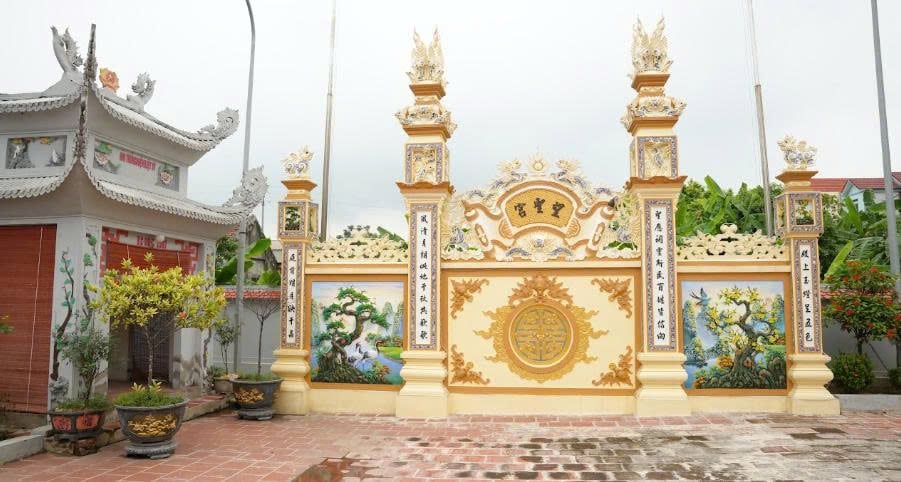
Passing through the communal house gate, visitors will encounter Ceremonial gate – the structure that begins the worship space. The Nghi Mon was built in the style of three-passage pillar gate, in which the main passage stands out with two large pillars, creating a sense of grandeur and solemnity.
On top of the pillars is the image of a phoenix exquisitely embossed. In traditional Vietnamese art, the phoenix is a sacred creature symbolizing nobility, purity, and the connection between heaven and earth. The image of the phoenix standing atop the pillar is not only decorative but also expresses the concept of harmony between humans and the spiritual world.
Immediately below is Hồ Phù together with the lantern-cell system decorated with Four Sacred Creatures motifs (Dragon – Qilin – Turtle – Phoenix), symbolizing strength, endurance, and blessings. The bodies of the pillars are also carved with pairs of Chinese-character couplets praising the beauty of the communal house and the merits of the village tutelary deity.
On both sides of the main path are secondary gates in the style of two-tiered, eight-roofed stacked eaves, connected to each other by low walls decorated with seal-script patterns. Square and round window openings are arranged alternately, both creating an architectural accent and conveying the meaning of harmony between heaven and earth according to Eastern thought. On top of the two small symbol pillars are placed a pair of kneeling mythical nghê lions, symbolizing protection and the preservation of the solemnity of the worship space.
Dai Bai
Beyond the courtyard paved with Bát Tràng bricks is the Đại Bái main hall, where the main rituals of the communal house take place.
The Đại Bái consists of three main bays and two side bays, its roof spreads wide and is covered with small-tip tiles. On the ridge stands out the image of two dragons flanking the moon, at the two ends of the roof are a pair of kìm ridge ornaments and softly curved đầu đao corner upturns, decorated with dragon and phoenix images, creating a graceful appearance while still preserving the grandeur of the structure.
Inside the Đại Bái, the entire wooden frame system is made in the style of “upper giá chiêng, rường nách; lower kẻ chuyền,” a traditional structure common in Vietnamese village communal-house architecture. The columns, beams, rường, kẻ, and bẩy are firmly connected, both ensuring load-bearing capacity and creating a balanced beauty for the interior space.
The decoration on the architecture is not overly elaborate but refined, with cloud motifs, curled patterns, and upturned-leaf motifs and carved lines in the shape of bamboo-shoot sheaths – familiar motifs in traditional wood-carving art.
Worship space
The central bay of the Đại Bái is a solemn worship space. Here hangs a red-lacquered, gold-leafed horizontal plaque bearing four Chinese characters:
「翼保中興」
Dực Bảo Trung Hưng
On both sides are pairs of couplets praising the merits of the village tutelary deity. Below is placed an incense table together with a set of Bát Bửu (Eight Treasures), creating a solemn and sacred worship space.
Rear Sanctuary
Connecting to the Đại Bái is the ống muống corridor built in an arched style, where the palanquin and incense table are placed before entering the Hậu Cung rear sanctuary.
The Hậu Cung is divided into two parts.
The outer part consists of three bays with a simple but sturdy structure. Here are placed the long đình dragon palanquin, incense table, and a horizontal plaque inscribed with four characters:
「顯應威靈」
Hiển Ứng Uy Linh
On both sides hang a pair of couplets:
“First-rank examination honor is recorded in Vietnamese history
Through the dynasties, three rolls of edicts sealed the covenant at Đồng Giang.
The interior is the most sacred space of the communal house. The structure was built with closed gable walls, a roof covered with ri tiles, and a truss structure using passing beams.
High above hangs a horizontal plaque:
Eternal heroic spirit
Eternal heroic spirit
On both sides is a pair of couplets:
Cinnamon mats and willow radiance, punishment through three generations;
The Đồng Đình temple affair, a village's shrine.
In the center of the Rear Palace is a three-tiered altar, where the dragon throne, memorial tablet, incense bowl, and many valuable ritual objects are placed, creating a sacred and solemn space—the center of the entire relic site.
TRADITIONAL FESTIVAL