
THI MAI LINH COMMUNAL HOUSE
Introduction
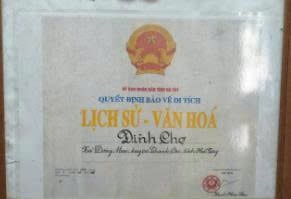
The old name of the relic is Thi Communal House, the communal house shared by the people of 4 villages of the former Mai Linh commune: Co Ban, Nhan Hue, Y Son, Nhan Son, and Yen Phuc villages. When Dong Mai commune was established, Thi, Mau, Cong, and Dong Hoang villages (former Yen Phuc commune) were added. Thi village also has a Thi Communal House; to avoid confusion with the relic's place name, people in the commune now call the Thi Communal House of the former Mai Linh commune Cho Communal House. The communal house stands on the land of Mai Linh commune's market, which has existed for a long time. The Sino-Vietnamese character “Thị” also means “market”. The current name Cho Communal House is therefore appropriate.
The communal house worships the village tutelary deity: Ly Trien – a talented general of the Lam Son uprising who bravely sacrificed his life in the resistance war against the Ming invaders, regaining independence for the nation.
The explanation of the historical context and career of the deity is as follows:
At the beginning of the 15th century (1406), the Ming dynasty (Taizu) mobilized 200,000 infantry and cavalry along with hundreds of thousands of laborers to invade our country.
The resistance led by the Ho dynasty failed. In 1407, Ho Quy Ly and other leaders of the Ho dynasty were captured by the enemy.
Our country fell under the brutal domination of the Ming dynasty. They turned our country into districts and counties and established an administrative apparatus of domination down to the prefectures, sub-prefectures, and counties.
Unwilling to accept the loss of the country, in 1416 at Lam Son Mountain (Tho Xuan, Thanh Hoa), Le Loi and many patriots gathered and organized an uprising. Under Le Loi's command, many talented people were attracted, such as: Nguyen Trai, Le Lai, Dinh Liet, Tran Nguyen Han, Nguyen Xi, Pham Van Xiu, Ly Trien...
Having mobilized the entire people for the resistance, the insurgent army won wherever it fought, “the more they fought, the more they won,” “they smashed the enemy wherever they went like splitting dry bamboo” (Nguyen Trai).
The Tot Dong – Chuc Dong Battle: In the Dinh Mui year (1427), Ly Trien and other generals ambushed the enemy at Tao Dong – Tu Liem (i.e., Xuan Thuy). In fierce fighting, Ly Trien and his soldiers charged left and right. On the Tao Dong battlefield, he was wounded; he rode his horse back through Ninh Kieu (Mai Linh commune) and died there.
Ly Trien was a talented general with great merits in the Lam Son uprising. He once killed the enemy general Phung Quy, together with generals Le Kha and Le Bi captured the enemy general Ly Luong alive, and destroyed hundreds of enemy soldiers at Nhan Muc Bridge...
When Le Loi ascended the throne, he reviewed merits and rewarded, ranking Ly Trien among Great Meritorious Officials, granted the national surname and called him Le Trien. Special favors were granted to his father Le Di with the title Quan Cat Su, his son Le Lang with the title Ngu Phong, and the people of 5 villages of Mai Linh commune were allowed to build a temple to worship him.
Location and terrain: Cho Communal House is located on high land on the right bank of the Day River, with a wide river frontage in front. The terrain is flat, the soil is fertile, and it is a site renowned since ancient times.
Current state of the relic: Through many wars and natural impacts, the original relic is no longer intact. The old architectural complex covers an area of about 1 ha, including the following items: Tam Quan (three-entrance gate), Tien Duong (front hall) area, Ta Huu Vu (left and right wings), communal house yard, Dai Bai (main worship hall), and Hau Cung (rear sanctuary).
Architectural features:
Dai Bai: Some columns and beams have been dismantled, leaving only a small architectural section. Based on the roof trusses, carved architecture, footings, etc., it can be assessed that the relic was built/renovated around the mid-19th century.
Hau Cung: Built in the Dinh (丁) shape, consisting of 3 small bays. The inner bay is where worship objects and spirit tablets are arranged. The rear sanctuary has an area of about 19 m². The architecture is simple.
Total current area: The total land area is 2,563 m². The construction area of the two Hau Cung structures is 218 m², and the remaining 2,344.2 m² is the communal house yard and the area temporarily used by Ha Son Binh Transport Enterprise.



