Cong Village Communal House is located in the west of Ha Dong Town; to reach the relic, one can take the main roads as follows:
From Ha Dong Ward, follow National Highway 6A to Ba La Intersection, turn left onto Provincial Road 21B toward Van Dinh, and upon reaching the area of Bich Hoa Commune, now Binh Minh Commune, turn right onto the inter-communal road up to the Day River dike for about 7 km to reach Cong Village. The communal house is located at the edge of the village.
From Ha Dong Ward, follow National Highway 6A to the beginning of Mai Linh Bridge, turn left and follow the Day River dike road for about 3.4 km to the beginning of the village, then turn left and go 700 m to reach the relic.
The route is convenient for all road vehicles.
According to the Han-Nom documents still kept at Cong Village Communal House and the accounts of village elders, the communal house worships Great King Hoang Khac Minh as the village tutelary deity. His life and career have been passed down through many generations and have become a source of pride for the local people.
Great King Hoang Khac Minh, whose courtesy name was Hoa Tinh, pseudonym Thuy Hien Tien Sinh, born in Quy Dau (1453) in a family with a Confucian tradition. His hometown was in Huyen Khe Village, later renamed Huyen Sy, then Dan Sy, in the former Thanh Oai district, now Da Sy village, Kien Hung ward, Hanoi city.
He was the eldest grandson of Hoang Trinh Thanh, a notable figure with great virtue and career achievements of our country under the Early Le dynasty. From childhood, he was renowned for his intelligence. Because his father died early, he was raised directly by his grandfather from infancy. As he grew up, he absorbed the great thoughts of Confucianism such as "loyalty through filial piety", upholding the way of filial piety, "wisdom, benevolence, and great righteousness", practicing moral integrity "impartiality, clarity, and integrity". It was these ideas that forged in him the aspiration to serve the king and the country from a very young age.
When he turned ten, his grandfather passed away. King Le Thanh Tong was extremely grieved and sent 50 court officials to offer condolences. Also from his grandfather's funeral, he had the opportunity to understand more about rituals and rules in officialdom, laying the foundation for his later career as an official.
It was not until the age of 32, under the reign of King Le Thanh Tong, with the era name Hong Duc 15th (Giap Thin – 1484), that he participated in the examination and passed the Third Class of Doctoral Laureates.
After passing, he was trusted by King Le Thanh Tong and appointed to the position of Boi Tung, Right Vice Minister of Rites. In his work, he was always known as an honest, upright, and dedicated person, so he continued to be promoted by the king to Grand Secretary of the Eastern Pavilion.
A typical story about his upright character is still passed down today. Legend has it that after returning from a visit to Dai Dinh, King Le Thanh Tong intended to depose the Queen and install a Concubine. In response, His Highness the Great Prince Hoang Khac Minh submitted a petition to remonstrate.
"...Within the women's quarters, the proper course is to enhance the demeanor of sincere generosity and brilliance. Why does one not recall the example of Su Wu and the saying 'a long tongue is the ladder of disaster'..."
That means:
"In the women's quarters, one should increase the diligent, sincere, and radiant style. Why not remember the story of Su Wu and the saying 'a long tongue is the ladder of disaster'?"
After reading the petition, King Le Thanh Tong praised him profusely:
"I have a group of frank and upright ministers; the state has truly upright officials."
The king's intention to depose the Queen and install a Concubine was then annulled. Also from this event, His Highness the Great Prince Hoang Khac Minh was promoted to Minister of Rites and was granted the title Lord Luong Nhan.
During his tenure, His Highness Great King Hoang Khac Minh was repeatedly ordered to serve as an envoy and to inspect localities throughout the country. To him, every task was a great responsibility to the court and the people. In his work, he always remained cautious and fair, clearly distinguishing right from wrong, and judging people and matters with reason and humanity.
Not only did he value people's qualities, he also paid special attention to the people's livelihood. According to tradition, he shared his salary with the people in the places he passed through. With a compassionate heart, he always wished for everyone to live with humanity and righteousness, in solidarity and love.
In addition, he regularly advised his descendants and the people to take care of their studies from a young age so that they might later have the opportunity to contribute to the country. He always encouraged everyone to keep faith in the future, taking study and moral cultivation as the foundation for building a life and career.
With his integrity, virtue, and talent, His Highness Great King Hoang Khac Minh was always trusted and highly regarded by the king. At the age of 70, he asked to retire and return to his hometown.
After returning to his homeland, he continued to spend time caring for and teaching his descendants. The people in the area respected him and wished to be close to him to hear his teachings. Therefore, the king also repeatedly bestowed precious gifts on him in recognition of his merits and virtues.
On At the Hour of the Dragon, on the 12th day of the twelfth lunar month of the Giap Ngo year (1534), His Highness Great King Hoang Khac Minh passed away peacefully, at the age of 82.
After his death, people from many villages in the area, including Cong Village in Dong Duong Canton, came to the Hoang family ancestral house to perform a ceremony and requested to bring his biography and honorary title home to worship him as the village tutelary deity.
Cong Communal House is located facing southwest on the land of outstanding people in Thanh Oai. In the distance to the right of the relic is the historic Day River, and in front is a vast field. These natural elements have partly affirmed the 'sacred' quality that previous generations chose in the orientation and position for building the communal house. With the Day River on the right, according to feng shui theory, this is the watercourse that has contributed to creating an area of heroic natural energy in this land of Ha Tay, a land of outstanding people.
The current relic complex includes main architectural items such as the ceremonial gate, the main worship hall, and the rear sanctuary. The communal house also has a brick-paved courtyard system, land within the relic area, and a fruit-tree garden. Originally, Cong Communal House had all architectural items such as left and right corridors, the main worship hall, and the rear sanctuary. But through war and time, the left and right corridors were damaged. Currently, the main architectural items of Cong Communal House include the ceremonial gate, the brick-paved courtyard system, the main worship hall, and the rear sanctuary.
The first item we encounter when entering the relic is the communal house gate. With its particular terrain, Cong Communal House did not open its gate at the front like other traditional communal houses, but opened it on the right side of the house. The gate of Cong Communal House was built with two monumental pillars on both sides; on the pillars are lantern panels, and the pillar bodies are decorated with raised ridges. The main gate is opened when the village holds a festival, and beside the main gate a small gate is opened for everyday passage.
From the gate, the first item we encounter is the ceremonial gate with monumental pillars, with two pillars made of gravel. On top of the pillars are raised four-directional lamps stylized into dragons. The phoenix symbolizes the operation of the universe and the movement of the sky close to the power of the saint. The phoenix standing on the pillar represents the yin-yang axis, the cosmic axis, connecting the earthly world with the spiritual world and bringing vitality from heaven down to mother earth. Next is the ho phu lintel, whose base has four dragon heads extending majestically in four directions. Below is a two-sided lantern panel with raised decorative ridges; inside the lantern panel are reliefs of the four sacred creatures (dragon, unicorn, turtle, phoenix). The pillar body bears parallel sentences in Chinese characters praising the beauty of the communal house as well as the merits of the village tutelary deity. The two pillars on both sides are flanked by two low walls.
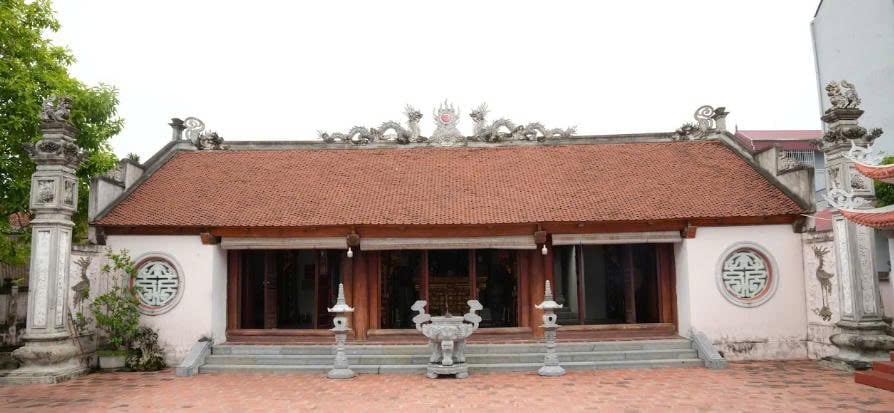
From the ceremonial gate, across a large courtyard paved with bat-cu bricks, is the main worship hall of Cong Communal House. The main worship hall of Cong Communal House is a three-bay house with gable ends closed by walls, two sloping roofs covered with old tiles, a ridge and eaves decorated with trim, and the two ends of the ridge decorated with nail heads.
Inside, the roof trusses are made uniformly in one style: 'gia chieng, ke chuyen treu qua giang tron hang cot'. Connecting the two ends of the hidden pillars in a mortise-and-tenon manner is a large, sturdy first beam; the back of the first beam is supported by two hidden pillars, with one end resting on a diamond-shaped square mortise base. The two ends of the hidden pillars are mortised into two ke beams supported by the upper purlin. The ke beam is mortised from the hidden pillar through the hidden column and joins the qua giang to support the upper and lower purlins. The entire truss rests on the qua giang. The trusses of the main worship hall are also linked to one another by a system of upper and lower beams running along the house. The front of the main worship hall opens three doors as passages when entering to worship the saint.
The rear sanctuary of Cong Communal House is a three-bay house built in the 'inner hidden, outer visible' style. Seen from outside, the rear sanctuary has gable ends closed by walls, two sloping roofs covered with tiles, a ridge decorated with trim, the two ends of the ridge decorated with two 'hau chinh', and below the eaves a low wall built with lime mortar. Inside, the roof trusses outside are made in two slightly different styles: the two trusses of the side bays are made in the 'con me' style; the con panels are right triangles with the hypotenuse resting on the purlin; the con panels are carved very finely and meticulously, with folk themes such as the four sacred creatures (dragon, unicorn, turtle, phoenix), the four seasons (pine, chrysanthemum, bamboo, plum), 'dragon winding through water', or forests with animals...
The two middle trusses are made in the 'con me' style. The con panels here are also made in isosceles triangles, decorated with stylized leaf and coin patterns. Generally, when previous generations created themes such as dragons winding through water, it was to pray for favorable rain and wind and a bountiful harvest.
Inside the sanctuary, the roof trusses are made slightly differently: the two trusses of the middle bays are made in the style 'upper stacking with con nhi, lower leaning against ke'. Connecting the two ends of the main pillars is a large, sturdy first beam; the back of the first beam supports two nuong, and the nuong lying close to the first beam is cut into a variant form called con nhi.
TRADITIONAL FESTIVAL
No one knows exactly when Cong Village Festival began, but with the awareness of preserving the traditional cultural values left by their ancestors, the people of Cong Village have passed it down from generation to generation, year after year reenacting the same rituals as the year before. The village's traditional festival is held with the awareness of honoring and respecting the deity they worship, and on the other hand, it strengthens the community solidarity of agricultural residents. The village festival takes place regularly every year, from the 11th to the 13th day of the first lunar month.