
Ha Village Communal House, Ha Phung Xa Village, Hong Son Commune, Hanoi City
Introduction
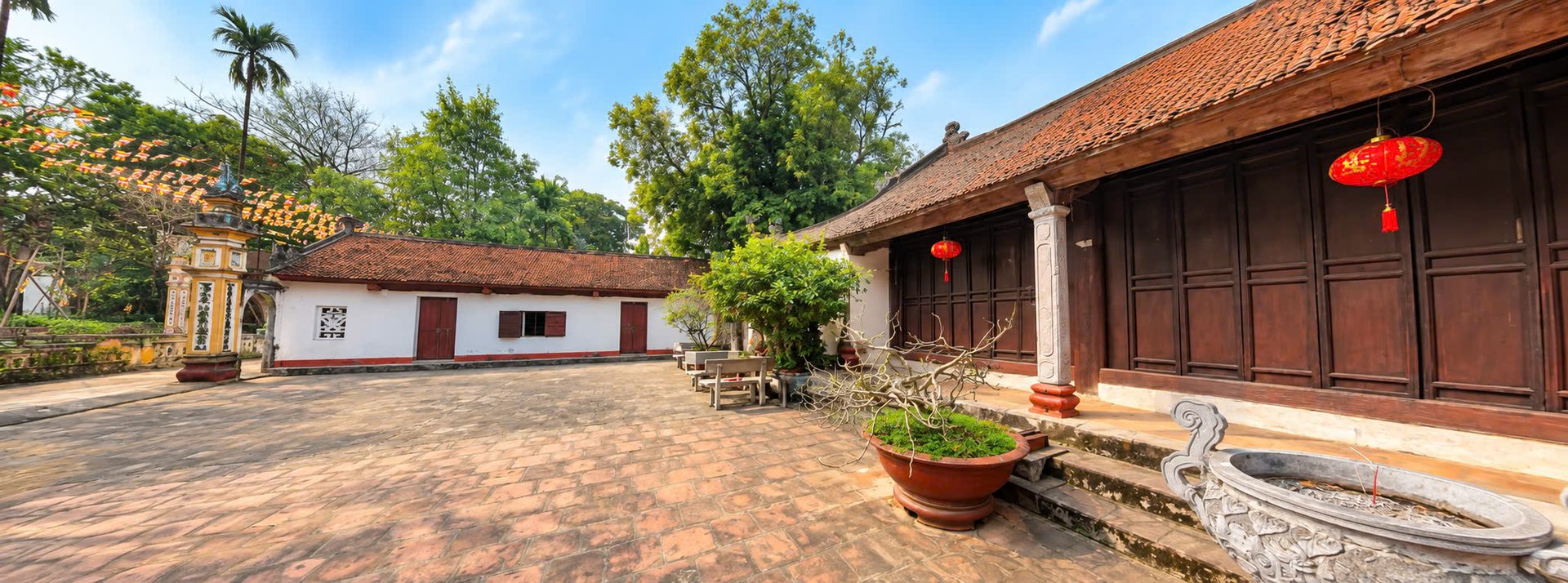
Ha Village Communal House is located in Ha Phung Xa Village, Hong Son Commune, Hanoi City.
The communal house was ranked as a city-level historical and cultural relic under Decision No. 651/QD-UBND dated May 21, 2002, of the Hanoi City People's Committee.
The name “Ha Village Communal House” comes from the name Ha Village, an ancient village in Hong Son Commune, Hanoi City. The communal house is not only a place of worship but also a cultural activity center, closely associated with the local people's religious activities and festivals.
According to the genealogy compiled by Nguyen Binh, Grand Secretary of the Dong Cac Academy, in the first year of Hong Phuc (1572), Ha Village Communal House worships the deity Duc Thanh Pha Thong Thuong Si Dai Vuong.
He was the one who helped the people build pagodas, taught them farming, and build a prosperous life. His merits were revered by the people, and after his death, King Ly Nhan Tong conferred on him the title of Phuc Than (Blessing Deity) and ordered the construction of a communal house for worship so that incense would be offered for generations.
Ha Village Communal House is an ancient communal house that has preserved almost intact the architectural style and features of the Le Dynasty. It was built in the shape of the Chinese character Dinh (丁), including main components such as Dai Bai, Hau Cung, Ta Huu Mac, and the courtyard and garden.
• Dai Bai Hall: Consists of three bays and two wings, with a soaring curved roof covered with old ri tiles. On the roof are reliefs of dragons and nghe mythical creatures; on the ridge are two kim creatures holding the ridge.
The interior is decorated with a system of sturdy lim wood columns and exquisite carvings. Notably, the communal house still preserves its original con panels; the con panels in the central bay are all carved with the theme “Ngu long hy thuy” (dragons playing in water). At the center of each panel is a large dragon hiding among clouds and water. Beneath the dragon is a carp leaping up from the water's surface, expressing the aspiration of a carp turning into a dragon. All the con panels are also embellished with animals such as birds, phoenixes, turtles, dragons, and horses…
Other con panels are carved with the four sacred creatures (dragon, ly, turtle, phoenix) and the four noble plants (pine, bamboo, chrysanthemum, apricot).
In addition to the con panels, the ke and ke bay elements are also carved in relief with dragons and stylized flowers and leaves, making the interior of Ha Village Communal House very lively, retaining the appearance and original style of ancient architecture.
• Hau Cung (Rear Sanctuary): The place where the memorial tablet and throne of Duc Thanh Pha Thong Thuong Si Dai Vuong are located. The architecture here is deeply solemn, with a system of horizontal lacquered boards and parallel sentences gilded and painted red.
• Ta Huu Mac: Two symmetrical five-bay side buildings, creating a harmonious landscape; they serve both as spaces for community activities and as venues for important ceremonies.
Ha Village Communal House – an unmissable destination for those who love Vietnamese history and culture.



