
Thon Thuong Communal House, Thuong Phung Xa Village, Hong Son Commune, Hanoi City
Introduction
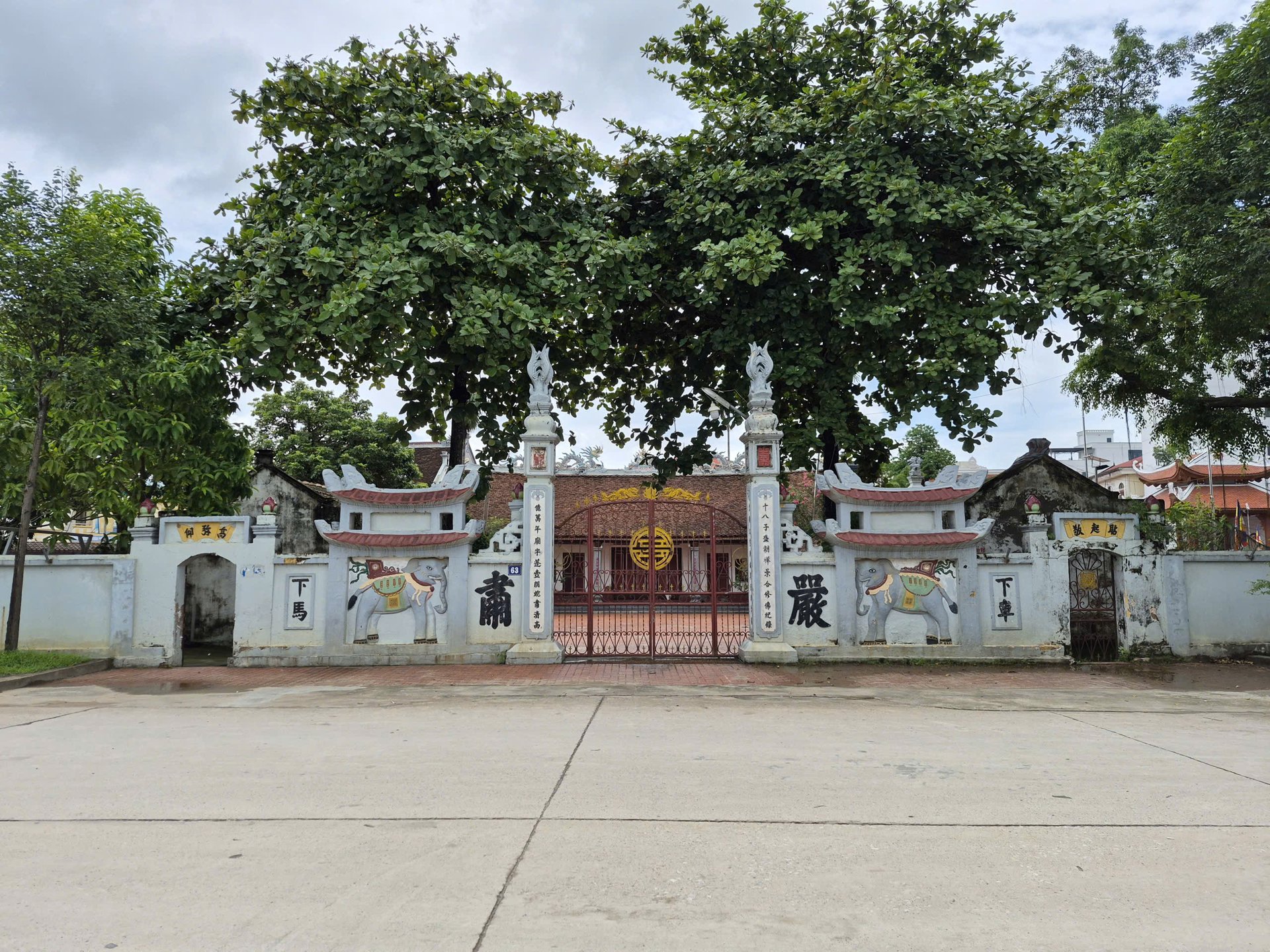
The name “Thon Thuong Communal House” comes from the name of Thuong Village, in Phung Xa Commune, My Duc District, Hanoi. Historically, Thuong Village was also known as Bung Village, a land with a long-standing cultural and historical tradition.
Thon Thuong Communal House is a place of worship for Lady Phat Cac Hau Phi. According to legend, she was a concubine of King Ly Thanh Tong, but because she had no son and felt she was old and of little virtue, she asked the king for permission to visit pagodas and make offerings to the Buddha. She stopped in the land of Phung Xa, had pagodas repaired, statues carved, bells cast, and practiced Buddhism there. After her death, the local people built a communal house to worship her in remembrance of her merits.
Thon Thuong Communal House is a work in the Nguyen architectural style, built with a Dinh (丁) layout, including many important components:
• Ceremonial Gate: The communal house gate has three entrances with two large ornamental pillars, topped with relief images of the four sacred creatures (dragon, unicorn, turtle, phoenix). The pillars are inscribed with Chinese-character couplets praising the merits of the village tutelary god.
• Main Hall: Including 5 bays and 2 side bays, built with closed gable walls, roofed with ri tiles, and in the center of the roof ridge is a relief of two dragons flanking the moon – a traditional symbol in Vietnamese communal houses. The Main Hall still preserves intact the sets of traditional wooden architectural frames from the Nguyen period, densely and concentratedly expressed in the brackets, beams, and purlins with motifs of dragons, leaves, and clouds. The beam ends in the central bay are carved as a dragon head with bulging eyes, a mouth holding a pearl, catfish whiskers, bared teeth, and manes flowing backward.
In particular, the corner bracket in the central bay is carved with the theme “four sacred creatures and four noble plants,” with a large dragon at the center. The decorative carving lines on the wooden architectural details are in relief imitating raised carving in the artistic style of the Nguyen period. In the central bay of the Main Hall hangs a wooden horizontal plaque lacquered red and gilded with three Chinese characters “Toi Linh Tu”.
• Central Hall: This is where the incense table, incense bowls, and important worship objects are placed, connecting the Main Hall and the Rear Hall.
• Rear Hall: This is the most solemn area of the communal house, consisting of 3 bays; the central bay is where the altar of Lady Phat Cac
Hau Phi is placed. The Rear Hall is solidly designed, with many horizontal plaques and couplets praising the merits of the deities.
In addition, the communal house also preserves many precious artifacts such as stone steles, bronze bells, incense burners, horizontal plaques, couplets, and processional palanquins – all of great artistic and historical value.



