
Tri Chi Village Communal House
5.0Free
5.0Free
Introduction
TRI CHI COMMUNAL HOUSE
TRI CHI COMMUNAL HOUSE
Located in the middle of Tri Chi Village, Phuong Duc Commune, Hanoi City, Tri Chi Communal House is an artistic architectural relic of outstanding value in the former Phu Xuyen land. Historically, Tri Chi Village belonged to Hoa My Canton, Phu Xuyen District, Thuong Tin Prefecture, Son Nam Thuong Commandery; in folk language it was also called Chảy Village, Trể Village, or Trê Village. Through changes in administrative boundaries, the communal house has remained a place where spiritual life, historical memory, and community affection of many generations of local people converge. With its architectural, artistic, and historical values, the communal house was ranked as a National-level Relic in 1985.
The central value of Tri Chi Communal House is tied to the worship of Linh Lang Đại Vương as the village tutelary deity. According to the deity records and legends at the relic, Linh Lang Đại Vương is identified with Prince Hoang Chan of the Ly dynasty, a military general who fought on the Nhu Nguyet River defense line during the resistance against the Song invaders and died for the country. After his death, he was conferred titles by the royal court and worshipped in many localities. In the minds of Tri Chi people, the worship of Linh Lang Đại Vương therefore carries the meaning of commemorating a person who had merit in defending the nation, while also expressing the wish for a peaceful and prosperous village life.
The religious space of the communal house is even richer because it also jointly worships Đông Hải Đại Vương and Thủy Hải along with deities who had merit for the people and the country. According to local legend, Đông Hải Đại Vương is Nguyen Phuc, a man skilled in transporting military provisions, who was later exonerated and deified. The communal house also worships Nghiêm Thắng and Đặng An, two saintly masters remembered by the villagers for teaching the craft of making palm-leaf raincoats, helping the people gain additional livelihoods. The combination of worshipping those who had merit in defending the country and those who had merit in transmitting a craft shows a very characteristic feature of Vietnamese village belief: the people honor both those who protected the community and those who helped the community build its life.
Tri Chi Communal House is also an architectural work of high artistic value. According to Hanoi city documents, the communal house dates from around the 17th century; on the ridgepole there is still a Chinese-character inscription recording the milestone the year 1771, reflecting an important architectural layer of the Le Trung Hung period. The complex currently includes Dai Bai, Trung Cung, and Hau Cung. Dai Bai has three bays and two side rooms, four curved roofs, and a frame system of 24 wooden columns; the beam ends, brackets, and purlins are carved with dragons, phoenixes, elephants, the four sacred creatures, and the four noble plants with the artistic imprint of the Le–Nguyen periods. The carvings, both solemn and rich in folk character, have created a distinctive appearance for the communal house.
Inside the communal house, many precious artifacts are still preserved, such as horizontal plaques, couplets, incense tables, ceremonial screens, thrones, and spirit tablets; in particular, there are ceramic lamps decorated with dragons in the Mac dynasty style, two celadon plates, deity records, and a system of royal edicts. A particularly meaningful event took place on October 30, 2022, when 22 royal edicts that had been lost were returned to the communal house after 16 years. According to Nhan Dan Newspaper, the communal house originally had 28 edicts, 27 of which had been lost. The return of the 22 edicts not only supplements valuable materials for the relic but also shows the community's affection and responsibility toward the heritage of their ancestors.
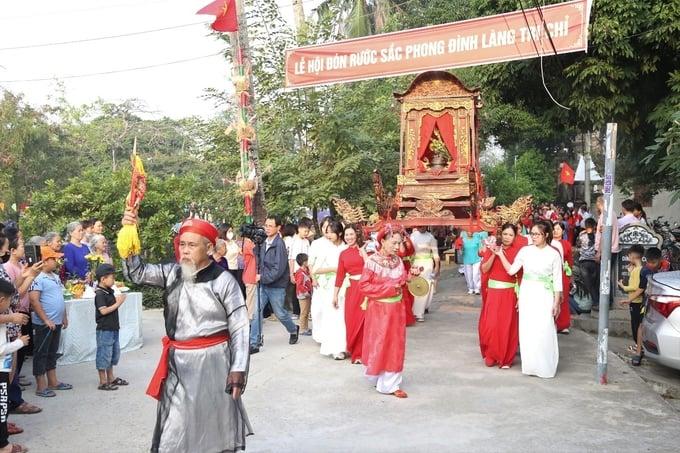
The cultural life of the communal house continues to be maintained through the traditional festival on the 1st to the 4th of the fourth lunar month and the 9th to the 10th of the eighth lunar month. The rituals of offering sacrifices and commemorating the tutelary deity not only meet religious needs but are also an occasion for Tri Chi descendants to return to their roots, meet, and strengthen village solidarity.
Tri Chi is also a land with a tradition of valuing education. Local documents record that this is the homeland of Ngo Nho (1756–1787), who passed the doctoral examination in the At Ty examination year of 1785, and once served as an official at the Hanlin Academy. When placed alongside the traditions of worshipping the tutelary deity, worshipping people with merit, and worshipping craft ancestors, the element of valuing education helps clarify the character of Tri Chi people: valuing righteousness, cherishing knowledge, respecting labor, and being conscious of preserving community values.
The relic is still being continually protected by the community and local authorities. Documents from the People's Committee of Phuong Duc Commune state In 2025, the restoration and embellishment project of Tri Chỉ Communal House was completed, accepted, handed over, and put into use. This is an important condition for preserving the long-term value of a national relic and gradually promoting the heritage in traditional education, sightseeing, and the development of cultural-tourism products of Phượng Dực commune.
Tri Chỉ Communal House is therefore not merely an ancient structure. Its roof is where the village's history is recounted through deity records, royal edicts, architecture, traditional crafts, and festivals; at the same time, it is a place where many generations of Tri Chỉ people express their gratitude to those who served the country and the people. Coming to Tri Chỉ Communal House is coming to a cultural space where patriotism, respect for righteousness, love of learning, and diligence in labor converge – values that contribute to shaping the identity of Tri Chỉ people and the land of Phượng Dực today.



