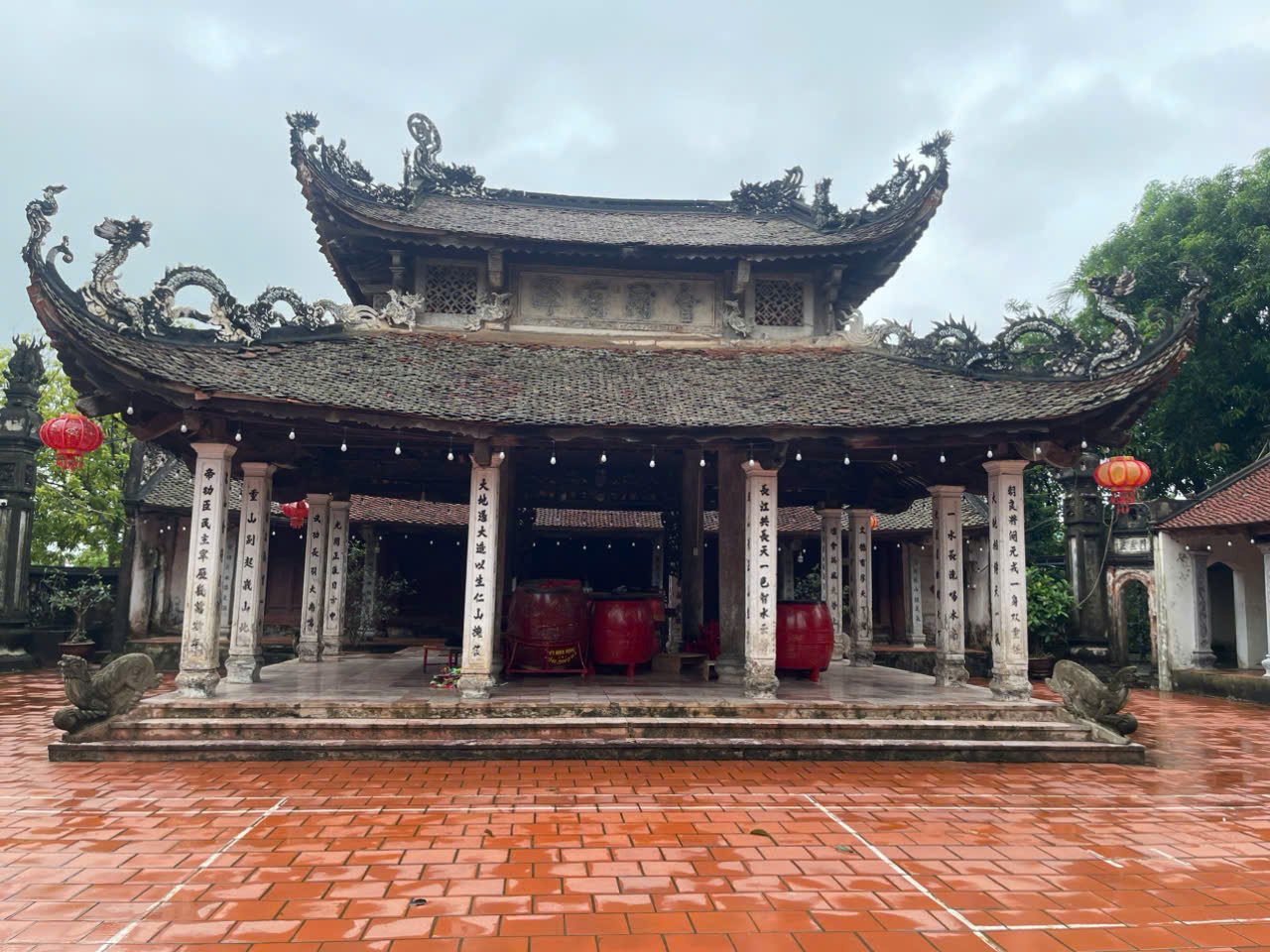
Thuong Van La Communal House, Van La Village, Hoa Phu Commune, Hanoi City
Introduction
Thuong Van La Communal House is located in Van La Village, Hoa Phu Commune, Hanoi City.
Thuong Van La Communal House is a religious architectural and artistic relic. The communal house faces southeast; according to ancient geographers, it was placed in a land position of 'Ton thuy nhieu tien', meaning there is a winding stream in front and behind it relies on the terrain of a Fire mound and a Metal mound. The communal house is a large-scale architectural work in the 'Noi Cong Ngoai Quoc' style. From the outside in, looking at the front, the architectural layers are arranged as follows: a medium-height screen, the second layer is a semicircular pond, across a large courtyard is the Thieu Huong pavilion (also called Phuong Dinh), then the Dai Bai Hall, then the rear sanctuary.
Besides its grand scale, what is noteworthy at the Dai Bai Hall of Thuong Van La Communal House is its talented architecture and carving. Using only the contemporary themes of the time, namely the 'Four Sacred Creatures' and the 'Four Noble Plants,' the ancient artisans skillfully depicted vigorous, firm lines with deep openwork and relief carving. The corbels mostly take the theme of dragons: 'Ngu long ly thuy' (fish-dragon playing in water); 'long nghe'; 'luong long chau nguyet' (two dragons flanking the moon)... but no two panels are repeated. In addition to orthodox themes, we also encounter familiar folk scenes: sunflower lotus, custard apple, pomegranate. Notably, at Thuong Van La Communal House, beneath the carved panels are purlins, side beams, small columns, paired column heads... everywhere there are elaborately stylized dragon-cloud, Nghe, squirrel, and floral motifs. The entire interior is densely decorated with relief panels but does not look chaotic; although symmetrical, it is not heavy but very flexible. The bases of the columns are stone pedestals about 0.4m high, divided into many decorative tiers with lotus flower and bodhi leaf themes, looking truly elaborate. In addition, in the Dai Bai Hall, the solemn beauty and artistic beauty are supplemented by artifacts with dozens of parallel couplets and horizontal plaques lacquered and gilded or inlaid with mother-of-pearl. For this ancient architectural work, those artifacts truly enhance its splendor.