
Thuy Linh Communal House
Good to know
- You should arrive early for an open and airy experience
- Free
- Convenient access by taxi or bus.
Introduction
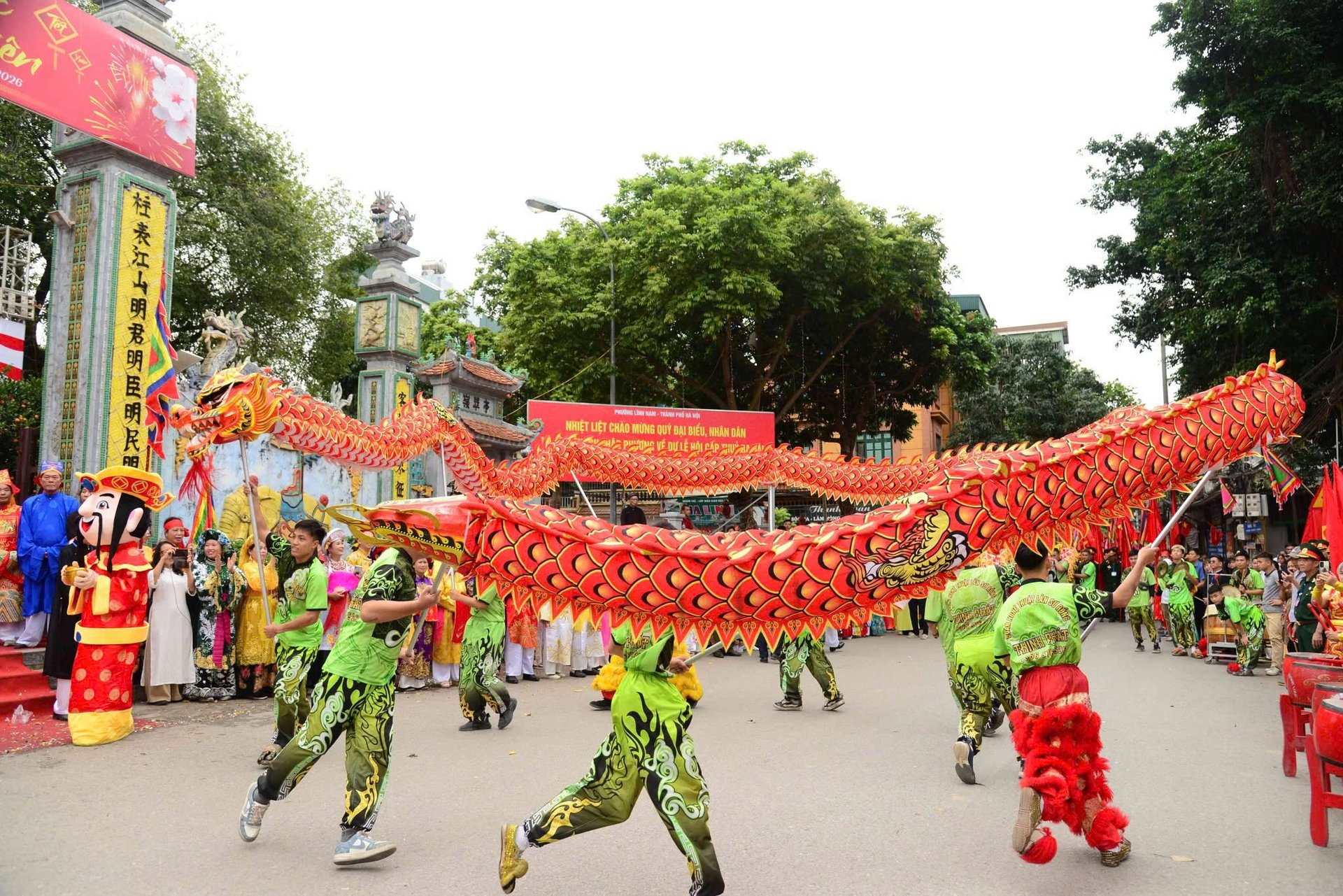
Thuy Linh is an important ancient land that guarded the southern waterway of the former Thang Long capital; it now belongs to Linh Nam Ward, Hanoi, lies along the silt-laden Red River, and has a long dike road together with a waterway and road transport system connecting it to the city, creating a rather beautiful landscape setting. Walking on the Huu Hong dike, one can admire the entire rivers-and-water scene of the ancient village of Thuy Linh, a fertile alluvial area outside the dike with a long history of human settlement and cultivation from early times[1]. Thuy Linh had the ancient names Thuy Ai Chau and Thuy Ai. Its residents' culture bears the characteristics of wet-rice agriculture. The territory of Thuy Linh village has changed little from the past to the present; it still lies entirely outside the Red River dike and borders the ancient villages of Dong Du, Tho Khoi, Bat Trang, Kim Quan[2], Nam Du, and Thanh Tri. Thuy Ai became a busy riverside village with boats below and a landing above, connecting the economy and cultural exchange with neighboring areas. The name Thuy Ai Chau summarized the natural features and agricultural production life of the residents of a village lying entirely outside the Red River bank, creating an immense and beautiful green. Thuy Ai means lovely green. The word Chau in Chinese 州 is a pictographic character imitating a river (the Xuan/Chuan radical 巛) with islands in the middle. Therefore, the character Chau 州 originally meant a mound of land rising in the middle of water, an islet. Later, at the end of the 19th century and the beginning of the 20th century, the village changed its name to Thuy Linh (翠嶺), meaning green mountains. It was so called because in the vast alluvial area amid this river-and-water region, throughout the year there rises a fresh green of plants, layered like mountain peaks. Thang Long - Hanoi is a capital region, a place where the refined beauty of the nation converges. It is also an ancient land bearing many marks of belief from historical periods, expressed in the mentality and worship customs of the people. One of the deities belonging to the Four Guardian Temples of Thang Long, specializing in protection and playing an important role in the spiritual life of every person in the capital region, must be mentioned: Duc Thanh Linh Lang. According to the classification of deities, Linh Lang Dai Vuong is a warrior deity[3]. The balls used in the festival. The worship of Saint Linh Lang originates from the belief in the Water Deity. 1 Not only that, if one goes deeper and peels back the cultural layers, according to many researchers, the worship of Saint Linh Lang actually originates from the water deity belief of ancient Vietnamese people, a characteristic cultural feature of wet-rice farmers. In essence, Linh Lang and the worship of Duc Linh Lang are a form of primitive indigenous spirit worship of the Vietnamese, later historicized, humanized, personified, and worshipped as a village tutelary god with meritorious military service. In origin, Linh Lang has a water-deity source, specifically a snake deity in the river-and-water region[4]. Generations of Thuy Linh people have been persistent and resilient, clinging to the land and village, diligently working to build a full and warm material life while maintaining good fine customs and traditions. Linh Lang Dai Vuong is revered by the people of the ancient village of Thuy Linh as the village tutelary god worshipped at the communal house. Located on the right bank of the Red River, the communal house stands on high, dry land in the middle of the village. The artifacts in the communal house are still quite rich, including a book of jade genealogy, six royal edicts, of which the earliest edict bears the era name of the 43rd year of Canh Hung (1782), a bronze bell bearing the era name of the 35th year of Tu Duc (1882), some horizontal lacquered boards, couplets, a palanquin, thrones, and valuable worship objects... The pair of Chinese-character couplets on the main pillars of the gate, seen from the road into the communal-house yard, praises the homeland of Thuy Linh. The central pillar on the right: 柱表江山明君明臣明民明世事 (Transliteration: Tru bieu giang son minh quan minh than minh dan minh the su). Meaning: The marker pillar defines the rivers and mountains with a bright king, virtuous ministers, wise people, and clear worldly affairs. The central pillar on the left: 榮光領土翠村翠木翠水翠人心 (Transliteration: Vinh quang lanh tho thuy thon thuy moc thuy thuy thuy nhan tam). Meaning: Glorious is the territory and borders, the village is green, trees are green, waters are green, and people's hearts are also harmonious and radiant with a color of spring and affection. Linguistically, the skillful wordplay when rivers and mountains is paired with territory reflects the reality that the village was considered a miniature country. Here there is a full set of separate social institutions such as village conventions, an administrative apparatus, tax collection, boundaries, population, natural resources, and social culture. In that whole, the village communal house is precisely a reflection of a miniature royal court. The people must be wealthy for the country to be strong. Vietnamese people for generations have still called it village - country. The worship of the village tutelary god is also understood more deeply as referring to royal power, the court, politics, rituals, and rules, not merely a local spirit deity. Similarly to the prosperous period of Buddhism in our country in history, the pagoda worshipping Buddha is not only a place to entrust spiritual aspirations but also carries the meaning of honoring the values governing the spiritual life of residents. Buddha is traditionally honored as the Dharma King - the king of all dharmas. From the perspective of social management, Dharma is also understood in a narrow sense as law and rules. Therefore, ancient villages, whether established early or late, considered building communal houses and pagodas the first condition for asserting the community's position, 2 while stabilizing residents' lives and local social order. The village tutelary god worshipped in Thuy Linh Communal House is Duc Linh Lang Dai Vuong (Duc Thanh Ca). According to the surviving Jade Genealogy, Linh Lang Dai Vuong was born on the 13th day of the 12th lunar month in the 6th year of the Chuong Thanh Gia Khanh era under King Ly Thanh Tong (1054-1072). He was the incarnation of Prince Hoang Chan[5], the fourth son of King Ly Thanh Tong and consort Nguyen Hao Nuong[6] in Bong Lai, Tu Liem district. From childhood, the prince understood military books and warfare; he followed his father the king to fight the enemy and won many great victories in the campaigns to defeat the Song and pacify Champa. When he went to battle, a troop of war elephants usually followed; whenever he gave an order, the elephants would kneel to obey. When he passed away, the people of 269 villages established temples to worship him and honored him as Linh Lang Dai Vuong. His main temples are in Thu Le and Bong Lai villages. Thu Le Temple has two kneeling elephants at its gate, called by the people the elephant temple in memory of his talent in commanding war elephants. Thuy Ai hamlet was also a place where a temple was established and built around 1497-1504. This temple later became Thuy Linh village communal house, now nearly 600 years old[7]. To remember his merit in protecting the country, the people of Thuy Linh preserve the communal house and offer incense and worship to Duc Thanh Linh Lang Dai Vuong throughout the year. Thuy Linh Communal House. He had great merit in expelling the Song invaders, as the couplet before the front hall records: 力散李朝功第一 (Transliteration: Luc tan Ly trieu cong de nhat) - Devoting strength to assist the Ly dynasty, merit ranked first. 驅除宋賊是無雙 (Transliteration: Khu tru Tong tac thi vo song) - Sweeping away the Song invaders, talent and achievement are unmatched. To record the great merit of Prince Hoang Chan in protecting the country, the king bestowed the sacred title: 靈郎大王 - 上等福神 (Linh Lang Dai Vuong - Thuong dang phuc than). In the front hall there is a couplet: 生爲將化爲神威武南邦第一 (Transliteration: Sinh vi tuong hoa vi than uy vu Nam Bang de nhat) - In life a general, in death a god; his prestige and martial achievements rank first in the southern country. 功在朝名在史流傳北海無雙 (Transliteration: Cong tai trieu danh tai su luu truyen Bac hai vo song) - Merit remains at court, name is recorded in history, fame spreads throughout the northern sea with no equal. 3 This is a couplet commonly used to praise and honor the outstanding merit and prestige of great generals and great national heroes in Vietnamese history who fought heroically to save the country and, after death, became guardian spirits protecting villages, their good reputation and merit remaining forever for all generations. If Duc Thanh Linh Lang represents the river-water deity, then Lord Bach Ho (Duc Thanh Hai) represents the mountain deity. The rear hall of the communal house also has an altar for Thanh Long opposite the altar of Lord Bach Ho, according to East Asian feng shui Left Thanh Long, right Bach Ho, common at places such as Ngoc Son Temple gate and Quan De Temple at 28 Hang Buom[8]... The rear hall of Thuy Linh Communal House. Initially, when Dien Khanh Pagoda existed, in the pagoda grounds there was a shrine dedicated to Bach Ho Dai Vuong[9], a powerful assistant of Linh Lang Dai Vuong. Over many years, exposed to wind and rain and weathering by nature, the shrine collapsed, so the throne and worship objects of Lord Bach Ho were brought by the people to be worshipped at Thuy Linh Communal House. In 2010, on the occasion of the great celebration of 1000 years of Thang Long - Hanoi, the State carried out restoration of the national-level relic Thuy Linh Communal House and also made some adjustments in the arrangement of worship there. Originally, Linh Lang Dai Vuong was the only principal blessed deity conferred as village tutelary god. However, according to East Asian cultural concepts, the number of altars must follow odd numbers (one or three deities). Therefore, in the rear hall, the altar of Duc Thanh Linh Lang is honored in the central bay, combined with the co-worship of Lord Thanh Long[10] in the right bay and Lord Bach Ho in the left bay (viewed from outside) as supporting deities. Thanh Long is also a river-water deity, an incarnation of Duc Thanh Linh Lang. Linh Lang Dai Vuong is the son of the Dragon Palace, ordered by Heaven to be reborn as a son of the royal family to help the country quell rebellion. After the four seas were peaceful, he returned to the Water Kingdom[11]. In the past, King Ly Thai To decided to move the capital from Hoa Lu to Dai La thanks to his far-sighted vision, early recognizing the sacred and important land here: It is in the center of heaven and earth, enjoying the posture of a coiled dragon and crouching tiger; it is correctly positioned in south, north, east, and west, and convenient for looking toward the river and leaning on the mountains; the terrain is wide and flat, the land is high and open, the people avoid the misery of flooding, and all things are extremely rich and verdant. Looking throughout our country of Viet, only this place is a scenic victory; it is truly the important convergence of the four directions of the country, and also the foremost capital of emperors for all generations. After moving the capital, King Ly Thai To changed the name Dai La to Thang Long, founding a capital city - the predecessor of today's Hanoi capital - with the aspiration that the country would always prosper and soar like a dragon rising. Thus, on the occasion of restoring Thuy Linh Communal House toward the 1000th anniversary of Thang Long - Hanoi, the co-worship of Duc Thanh Linh Lang (a prince of the Ly dynasty - village tutelary god) together with Thanh Long on the left 4 and Bach Ho on the right at the communal house was thoroughly researched by cultural experts on a scientific basis. Dragon attending and Tiger submitting is a rare feng shui land posture symbolizing supreme authority, a place where the spiritual energy of heaven and earth converges to give birth to an emperor ruling over this land; it is believed to accord with heaven's mandate, have enough authority to subdue ministers, keep the country stable, and bring national peace and people's security. The ancient village of Thuy Linh is like the shadow of a miniature nation, a place that fully converges the country's rivers and mountains. This unique harmony is reflected directly in historical names: sometimes Thuy Ai Chau, evoking the shape of a riverside alluvial delta, and sometimes Thuy Linh, carrying the stature of steadfast green mountains. Unlike most villages in the Northern Delta, which only use bells and drums in sacrificial rituals, this riverside village also resounds with the chieng - a musical instrument characteristic of the great mountains and forests. Not only that, the grandeur of mountain-forest culture is also present right at the communal-house gate through the image of two kneeling elephants, restored according to the original model at the famous Thu Le Elephant Temple[12]. The game of wading in the pond to catch ducks not only honors a typical product of the river-and-water region but actually also vividly recreates the time of reclaiming land and establishing hamlets in ancient times as well as the heroic struggles against foreign invaders of our ancestors. The traditional duck-catching festival in the ancient village of Thuy Linh (Linh Nam Ward, Hanoi) is a unique folk cultural beauty with a long history, closely linked to the development process of the capital region. The origin of the festival crystallized from the time our ancestors reclaimed the banks and established settlements along the Red River and is linked to struggles against foreign invaders. Stemming from the fact that ducks were a precious product of the river-and-water region, the duck-catching festival was initially organized as an activity to train the endurance and agility of soldiers and people under the leadership of Linh Lang Dai Vuong - the principal blessed deity and village tutelary god of Thuy Linh. Through many ups and downs, especially after the great restoration of Thuy Linh Communal House on the occasion of the 1000th anniversary of Thang Long - Hanoi, the festival has been invested in and organized on a larger and more systematic scale based on scientific research. Every year, after solemn rituals at the village communal house - where Duc Thanh Linh Lang together with Thanh Long on the left and Bach Ho on the right are reverently worshipped - the vibrant festival portion opens with great excitement. Under the cool water of the communal-house pond, strong young men compete amid cheers and resounding drumbeats to chase and catch swimming ducks. More than simply an entertainment game, this custom is a vivid mirror of the resilient labor history of the riverine alluvial residents. Today, the duck-catching festival still retains its core value, being an occasion for people to gather, strengthen neighborly ties, and pray for favorable weather, good harvests, and a prosperous life. As mentioned above, Thuy Ai landing had advantages for our people in water-battle formations against the enemy from the Ly, Tran, and Later Le dynasties to the Tay Son dynasty and also in the two resistance wars against French colonialism and American imperialism. After 5 this, many important events entered the history books. The duck-catching festival is one of the three main festivals of Thuy Linh village, maintained through many generations and closely tied to the life of the alluvial residents - where for generations, knowing the water and being able to swim have been necessary to adapt to seasons of rising water and rainy floods. Hoi is usually closely related to Le. Villages along the Red River with histories of several hundred years usually have two very solemn occasions for worshipping the tutelary god in spring and autumn, namely the Spring Sacrifice and Autumn Sacrifice. Local people and pilgrims, in addition to participating in spiritual rituals to the village tutelary god praying for national peace, favorable weather, and good harvests, also take part in distinctive folk games. At Thuy Linh, while the ball-wrestling festival is tied to the Spring Sacrifice at the beginning of the new year, in autumn near the Mid-Autumn Festival there is the duck-catching festival. These two folk games were formerly among the forms used by Lord Linh Lang Dai Vuong to train soldiers, encourage the nation's martial spirit, and at the same time preserve a unique feature in the colorful cultural picture of the thousand-year civilized capital. If in the ball-wrestling festival young men train their health on land, the duck-catching festival requires participants to be persistent and flexible in the river-and-water area. Legend has it that the ball-wrestling festival originated in the Ly dynasty and is closely related to the tutelary god of Thuy Linh village, Linh Lang Dai Vuong, and General Bach Ho. Linh Lang Dai Vuong and General Bach Ho, during the process of training troops to fight the enemy, often introduced various forms of sport to train soldiers. Each time Tet came and spring arrived, Lord Linh Lang often organized a ball-wrestling festival for soldiers to enjoy; that ball-wrestling sport was most favored by soldiers because it was a sport that not only trained soldiers' bodies and health but also gave soldiers tactical awareness, team spirit, enthusiasm and excitement, and determination, so that on the battlefield they could adapt to all conditions and circumstances. In the former Thanh Tri district, a saying still circulated: Boys of Thuy Ai, girls of Thanh Tri - the boys of Thuy Linh village are heroic, while the girls of Thanh Tri village are capable. The spring festival preserves the thousand-year martial spirit, with a loyal heart. Thuy Linh ball wrestling still resounds; the sacred soul of rivers and mountains remains forever full and whole. Therefore, the ball-wrestling festival in the ancient village of Thuy Linh fully carries the stature of a miniature nation, where the martial spirit of resisting foreign invasion to protect the country is crystallized. Thuy Linh ball-wrestling festival. That identity has been distilled over many generations, as the residents here had to endure countless hardships both to subdue fierce nature and to resolutely struggle to keep the land, thereby building up villages along the rich alluvial strip. Ball wrestling is an intangible folk cultural heritage that needs to be preserved and honored 6 to the level of national intangible heritage. Every year, the traditional ball-wrestling festival usually opens on the 4th day and lasts until the end of the 6th day of the Lunar New Year. On the occasion of restoring Thuy Linh Communal House toward the great celebration of 1000 years of Thang Long - Hanoi, the relic space was adorned with two splendid Bat Trang ceramic paintings, vividly recreating the two famous local folk festivals: ball wrestling and duck catching. Together with the communal-house yard paved uniformly with Bat Trang bricks, the work has become an architectural masterpiece, contributing a bright touch to the nation's treasury of architectural art heritage.
At Thuy Linh since the village was founded, people have developed wet-rice cultivation and mulberry growing and silkworm rearing on the banks, contributing to the Red River civilization and the glorious culture of Thang Long - Hanoi. With the advantage of lying along the Red River near the Thang Long capital, the land of Thuy Ai once had a busy trading port with a landing above and boats below, playing an important role in connecting the economy among regions. Archaeological results discovering Kaiyuan Tongbao coins from the Tang dynasty (8th century), Zhihe Yuanbao coins from the Song dynasty (11th century), along with traces of ancient brick-paved roads and many other artifacts, are important evidence affirming that Thuy Ai is an ancient Vietnamese village with a long history in the development process of Thang Long - Hanoi, a bridge connecting the economy and spreading culture, religion, and knowledge domestically and internationally. The presence of splendid ceramic materials decorating Thuy Linh communal house and pagoda also recalls a unique cultural contrast along the Red River civilization axis: if the left bank has the famous Bat Trang pottery village, then the Huu Hong side has the ancient village of Thuy Ai with its once-thriving mulberry growing and silkworm rearing. Thuy Linh village, Linh Nam Ward, Hanoi, is an ancient land along the Red River that preserves two profound cultural heritage symbols: the traditional ball-wrestling festival and the craft of mulberry growing and silkworm rearing. The prominent symbol of the martial spirit here is the jackfruit-wood ball, a round block of wood weighing more than 20 kg carved from the trunk of an ancient jackfruit tree. The ball-wrestling game at Thuy Linh Communal House simulates the troop-training method of Prince Linh Lang in the Ly dynasty and expresses the wish for favorable weather and good harvests. Alongside that heroic symbol is the image of mulberry leaves and silkworms, closely associated with the long-standing farming tradition on the fertile alluvial strip of the Red River. The merit of preserving and developing this sericulture and weaving craft is remembered by the people through the image of the Lady Deities who reclaimed land and cared for people's livelihoods. Through many historical ups and downs, Thuy Linh Communal House and Pagoda was ranked as a national-level historical-cultural relic in 1993, becoming a great pride of the capital's people. The ball-wrestling festival and the green of mulberry fields and gardens are not only distinctive intangible cultural beauty but also the core soul binding the community in the capital land of Thang Long. Today, these cultural symbols are still always treasured, preserved, and transmitted by generations of Thuy Linh people as an endless source of origin. Thuy Linh village will forever remain endlessly green with nature and agricultural landscape. That green full of vitality also contributes to the common green of the beautiful rivers and mountains, growing and developing sustainably for future generations.
REFERENCES [1] Party Committee - People's Council - People's Committee of Linh Nam Commune (2000). Traditional History of Linh Nam Commune. Ethnic Culture Publishing House.
[2] By the end of the 19th century, Kim Quan village was renamed Kim Lan.
[3] Nguyen Vinh Phuc and Nguyen Duy Hinh (2009). Tutelary Gods and Beliefs of Thang Long - Hanoi. Lao Dong Publishing House.
[4] Ha Tinh Provincial People's Committee. Little-known facts about Saint Linh Lang of the former Four Guardian Temples of Thang Long. Accessed 11.09.2026 at https://dhtn.hatinh.gov.vn.
[5] The people of Thuy Linh avoid the taboo name, calling khoai lang khoai day and chan cang.
[6] On the occasion of the 1000th anniversary of Thang Long-Hanoi (2010), Thuy Linh Communal House was restored; the villagers of Thuy Linh went to Bong Lai to perform rituals and request the Holy Mother's title to bring back and establish an altar on the right side of the central hall for worship.
[7] Linh Nam Ward People's Committee (2026). Report No. 345/BC-UBND Reviewing and assessing the current status and proposing plans to preserve and promote cultural heritage values for the Red River Landscape Boulevard Axis Project, July 13, 2026.
[8] https://redsvn.net/chum-anh-den-quan-de-ngoi-den-tho-quan-vu-giua-pho-co-ha-noi/
[9] The old pagoda was built during the reign of King Le Than Tong 1619-1643, in the third year of the Vinh To era (1622). The people of Thuy Linh avoid the taboo name, calling ho he.
[10] The deity was brought by the people from Nghe Shrine to the communal house.
[11] Dinh Khac Thuan (2011). Translation of the Jade Genealogy about Prince Linh Lang Dai Vuong of the Ly Dynasty. Institute of Han-Nom Studies.
[12] For mountain people, gongs are commonly used in rituals and important ceremonies.
More Other places
- Other placesVerified
Gioi Duc Pagoda (Hong An Temple)
Ung Hoa Commune
5.0Free  Other placesVerified
Hai Giac Pagoda
O Dien Commune
5.0Free Other placesVerified
Phuong Bang Pagoda (Hung Long)
Son Dong Commune
5.0Free Other placesVerified
Sung An Pagoda, also known as Sung Khang Pagoda (Dong Ba Pagoda)
Thượng Cát Ward
5.0Free
