
THỤY LÔI COMMUNAL HOUSE (NHỘI COMMUNAL HOUSE)
5.0Free
5.0Free
Introduction
THỤY LÔI COMMUNAL HOUSE
THỤY LÔI COMMUNAL HOUSE
Thụy Lôi Communal House, also known as Nhội Communal House after the village's vernacular name, is currently located in Thụy Lôi 1 Hamlet, Thư Lâm Commune, Hanoi City. This is a relic with a long history, closely associated with Sái Temple, Thượng Temple, and the Temple of Doctor Lê Tuấn Mậu, forming a relic complex with many distinctive historical, cultural, religious, and architectural-artistic values. The relic complex of Sái Temple - Thụy Lôi Communal House - Temple of Doctor Lê Tuấn Mậu was ranked as a National Relic under Decision No. 15 VH/QĐ/1986 dated January 27, 1986.
Thụy Lôi, or Nhội Village, Kẻ Nhội, was formerly called Ma Lôi, later renamed Xuân Lôi, and finally Thụy Lôi. This is an ancient village with a long history. Previously, Thụy Lôi belonged to Phương La Canton, Yên Phong District, Từ Sơn Prefecture, Bắc Ninh Province. At the beginning of the 20th century, Xuân Lôi separated from Phương La Canton to establish Thư Lâm Canton, Đông Ngàn District. After 1945, the three villages of Thư Lâm Canton—Thụy Lôi, Thư Lâm, and Đào Thục—merged into Thụy Lâm Commune, Đông Anh District, Phúc Yên Province. In 1946, Thụy Lâm and Thư Lâm merged into Đức Hợp Commune; in 1949, Đức Hợp Commune added Đào Thục Village to form Tiến Bộ Commune, Đông Anh District, Phúc Yên Province. From 1961, Đông Anh District was incorporated into Hanoi. In 1964, Tiến Bộ Commune was renamed Thụy Lâm Commune, Đông Anh District, Hanoi City. Currently, under the new administrative boundaries, the Thụy Lôi Communal House relic belongs to Thụy Lôi 1 Hamlet, Thư Lâm Commune, Hanoi City.
The land of Thụy Lôi has long been associated with many legends, traditions, and historical events in the nation's process of building and defending the country. Located to the northeast of Cổ Loa Citadel and Thăng Long Imperial City, this area formerly belonged to the 'Seven Stars Mountain' (Thất Diệu Sơn) space, with Sái Mountain associated with the legend of building Cổ Loa Citadel in the time of An Dương Vương; it also preserves traces and legends related to Saint Gióng. With the Cà Lồ River flowing through and its position on the route from Như Nguyệt to Thăng Long, this place once contributed to events in the resistance wars against the Song in the 11th century, against the Yuan-Mongols in the 13th century, and other struggles to protect the country.
During the resistance war against the Song, Nhội Village held an important position in the Cầu River battle line. A folk verse is still passed down:
“If you fight, fight across the river,
Do not fight across the fields and ruin people's rice.
If you fight, fight across Xà,
Do not fight across Nhội and ruin the houses of the Dâm people.”
This is also a land famous for its scholarly tradition. The name Thư Lâm—'forest of letters'—partly reflects the local tradition of learning and examination success. Throughout the Lê dynasty, from the reign of Lê Thánh Tông to that of Lê Hiển Tông, many local people passed examinations, became officials, and helped bring honor to their homeland. Notable examples include Nguyễn Thạch Trụ, Doctor in the Kỷ Sửu examination of 1469, who rose to the position of Left Vice Minister of the Ministry of Personnel; Lê Trinh Chấp, Doctor in the Mậu Tuất examination of 1478; Lê Tuấn Mậu, from Thụy Lôi Hamlet, who passed the Hoàng giáp examination in the Canh Tuất year of 1490, served as Minister of the Ministry of Finance and concurrently Censor-in-Chief, and once served as an envoy to the Ming court; Nguyễn Khắc Kiệm, Doctor in the Kỷ Mùi examination of 1499; Ngọ Cương Trung, Doctor in the Tân Mùi examination of 1511, who rose to the position of Censor-in-Chief; along with Đào Đăng Khiêm, traditionally regarded as the ancestor of the traditional water puppetry craft, whose clan temple still stands in Đào Thục Hamlet.
Thụy Lôi Communal House, Thượng Temple, and Sái Temple are part of an overall relic complex closely related in events, legends, and festivals. According to folk legend, Sái Temple is located on Sái Mountain, also called Vũ Đương Mountain or Mother Turtle Mountain. This place is associated with the legend of An Dương Vương building Cổ Loa Citadel. It is said that when the Thục King built the citadel, the work collapsed several times due to the White Chicken Spirit causing trouble on Sái Mountain. Later, Huyền Thiên Trấn Vũ sent the Golden Turtle Spirit to help destroy the White Chicken Spirit, and only then was Cổ Loa Citadel successfully built. To commemorate that merit, the king had a temple to Huyền Thiên built on the mountain peak, changed the name of Ma Lôi Village to Xuân Lôi, and every year came to perform ceremonies.
According to tradition, Thụy Lôi Communal House was built on the land that was once the royal resting place of King Thục An Dương Vương when he came to pay homage to Huyền Thiên. Because it served as a place for the king's temporary residence, the communal house initially did not have an altar for the Village Guardian Spirit like many other Vietnamese communal houses, but instead worshipped deities. Later, the communal house became a place of worship for four deities: Huyền Thiên Trấn Vũ, Cao Sơn Đại Vương, Thánh Tam Giang, and Đông Hải Đại Vương.
Huyền Thiên Trấn Vũ is associated with many legends about destroying demons and helping good people. In the legend of building Cổ Loa Citadel, Thanh Giang Sứ—the Golden Turtle Spirit—helped An Dương Vương destroy the demon on Thất Diệu Mountain and build the citadel. Deeply grateful for the merits of Huyền Thiên Trấn Vũ, the Thục King went to Vũ Đương Mountain and granted temple fields for the villagers to care for and worship. Every year in spring, the king and his officials returned to the temple to pay homage. Later, to reduce the burden on the people, the king assigned the villagers to perform the imperial ceremonial rites on his behalf, using assumed official titles to conduct the rituals, which became a customary practice.
Cao Sơn Đại Vương is a deity worshipped in many areas of the Northern Delta. Legends about Cao Sơn Đại Vương are very rich. One legend holds that Cao Sơn was the son of Lạc Long Quân and Âu Cơ; other legends say Cao Sơn was named Nguyễn Hiền and, together with his younger brother Nguyễn Sùng—also known as Quý Minh—helped Sơn Tinh fight Thủy Tinh and protect the Hùng kings. At the beginning of the Lê Trung Hưng period, Cao Sơn Đại Vương was especially exalted and recorded in many historical documents.
Thánh Tam Giang is a name associated with two brothers, Trương Hống and Trương Hát, generals who served Triệu Việt Vương in fighting the Lương invaders. The two were famous for their loyalty and righteousness and are worshipped by people in many areas along the Thiên Đức, Nguyệt Đức, and Nhật Đức rivers. Later dynasties continued to recognize and worship these two beneficent deities who helped the people and the country.
Đông Hải Đại Vương Đoàn Thượng, according to his spirit biography, was a figure from the Lý-Trần period, and many localities built temples to worship him and received dynastic titles. At Thụy Lôi, Đông Hải Đại Vương is also one of the deities revered and worshipped by the people at the communal house.
One of the special values associated with Thụy Lôi Communal House is the traditional festival within the overall complex of Sái Temple - Thượng Temple - Thụy Lôi Communal House. The King Procession Festival reenacts the legend of King Thục and Thanh Giang Sứ handing over the citadel to the resident official, going to Sái Temple to pray to Huyền Thiên, and destroying the White Chicken Spirit. In the festival, there are characters playing the King, the Queen/Princess, the resident official, and official titles such as Guard, Counselor, Commander, and Attendant. The characters are costumed, dressed, hatted, and perform traditional rituals.
During the festival, the procession performs many rituals at the communal house and relics in the complex. The King goes to Mô Hill to perform a remote homage to Huyền Thiên; then the Queen/Princess is carried to Thượng Temple to perform a ritual symbolizing the destruction of the White Chicken Spirit and to pay respects to Cao Sơn Đại Vương. The festival includes gongs, drums, eight-tone music, flags and fans, parasols, and many folk cultural activities. In addition to the main rituals, there are cửa đình singing, tuồng singing, and recreational activities such as wrestling, cockfighting, and chess, creating a lively festival atmosphere. Besides the King Procession Festival, Thụy Lôi Communal House also organizes ceremonies for the four deities worshipped at the communal house from the 10th to the 16th day of the ninth lunar month every year.
Based on the architecture, artistic style still preserved, and 34 royal edicts, the earliest of which dates to Phúc Thái 3 (1645), it can be determined that Thụy Lôi Communal House was built at least around the 16th-17th centuries. During its existence, the communal house was restored and repaired many times; it was moved in the year Ất Dậu 1885 and the year Tân Mùi 1931 to its current location. In 1997, the roof and rear sanctuary were repaired.
Thụy Lôi Communal House is the place where, according to tradition, the royal resting place of King Thục An Dương Vương once stood, and it is now a place of worship and remembrance for figures who rendered merits to the people and country from the Hùng Vương period to the Lý and Trần dynasties. The content of worship and architectural system show that the communal house is a religious and belief relic type with historical value that needs to be preserved.
In terms of architecture, the communal house was built on a large plot close to the residential area, facing northwest, with a Đinh-shaped layout, including the Main Hall, the tube-shaped passage, the Rear Sanctuary, two rows of left and right side buildings, and a four-pillar gate. The gate has four ornamental pillars; the two central pillars are larger, topped with facing nghê creatures; the two side pillars are smaller, topped with lanterns. Behind the gate is a large communal courtyard paved with old Bát Tràng bricks.
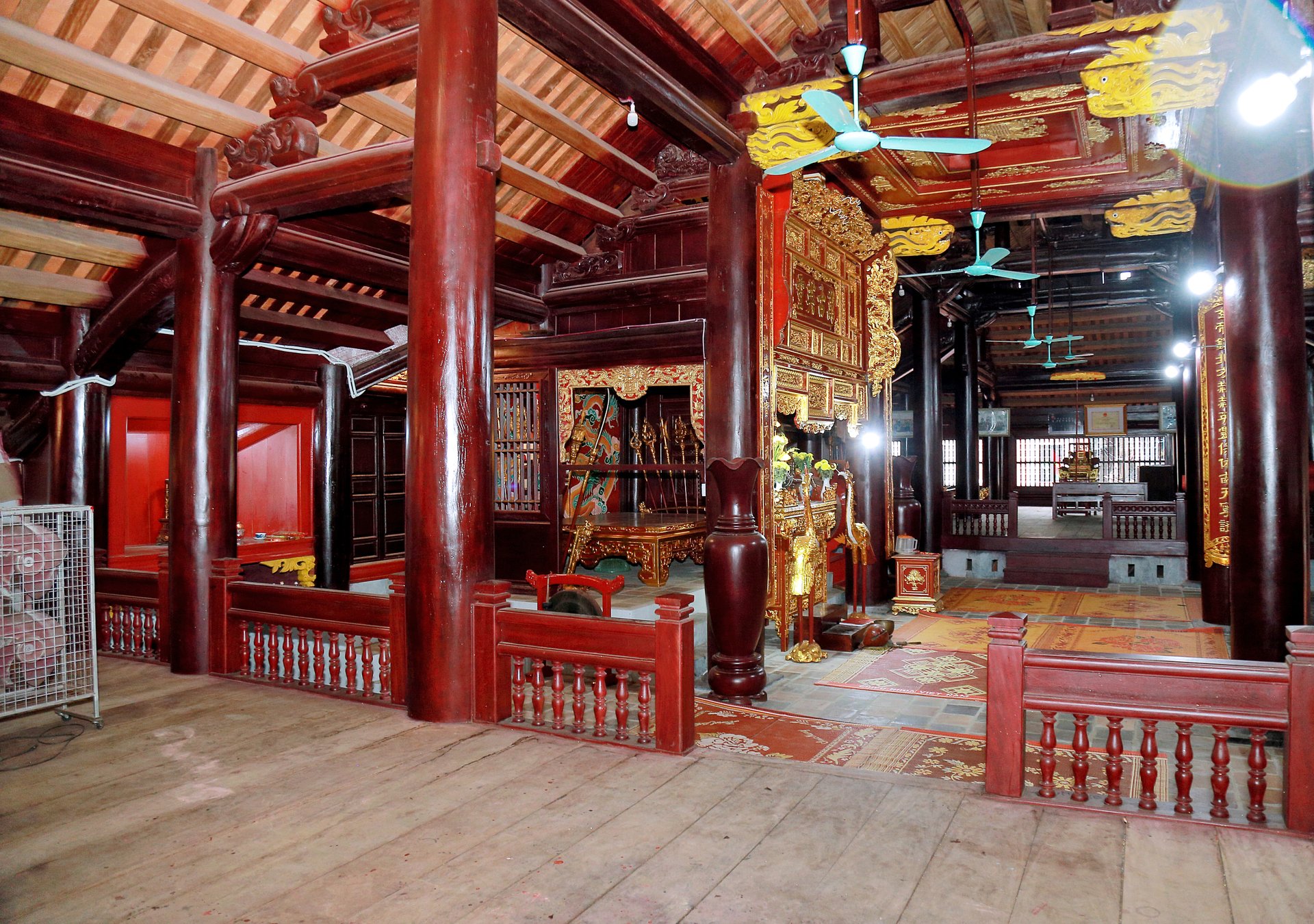
The Main Hall consists of five bays and two side wings, with a four-roof style and curved corner supports. The two front corner supports are decorated with dragons facing the roof ridge, and the communal house roof is covered with traditional tiles. The communal house floor is about 60 cm higher than the courtyard. The structure of the Main Hall includes six roof trusses placed on four rows of wooden columns. Previously, the communal house had a lim wood floor system, which was later dismantled during the resistance period; traces of the communal house floor remain on the columns.
The central bay of the communal house has a beautifully carved curtain door in the artistic style of the 19th century; above is a dragon facing the moon, followed by decorative panels of the four seasons, four sacred creatures, and water-curling dragons. In the center is a large horizontal plaque with four characters 'Vạn cổ anh linh' (Eternally sacred and efficacious). The architectural decoration system of the communal house is rich, bearing artistic imprints of the Lê and Nguyễn dynasties, shown on the brackets, beams, trusses, corner panels, and projecting beam ends with themes such as chrysanthemums, chrysanthemums turning into dragons, clustered clouds, billowing clouds, water waves, dragons, the four sacred creatures, and many other folk images.
The tube-shaped passage has a floor higher than the Main Hall; above it are placed a siêu đao and bát bửu. The roof is made in a two-tiered overlapping style. Adjacent to the Rear Sanctuary is a large horizontal plaque reading 'Thánh cung vạn vạn tuế' (Long live the sacred palace). The Rear Sanctuary has two wooden trusses, below which boards are joined to make an altar platform, on which are placed four long thrones, spirit tablets, and worship objects. Here there is also a large horizontal plaque reading 'Ngự thiên tứ đức', meaning the four saints worshipped at the communal house.
On both sides of the brick courtyard in front of the Main Hall are the left and right side buildings; each row has three bays and two side wings, roofs covered with traditional tiles, and brick-paved floors. The overall architecture of the communal house both conveys the grandeur of an ancient communal house and preserves many valuable traditional architectural and artistic elements.
Through a long period of time and historical upheavals, especially through the two resistance wars against the French and the Americans, some artifacts at the communal house were damaged or lost. However, Thụy Lôi Communal House still preserves a rich collection of artifacts of many types and materials.
Especially precious are 34 royal edicts conferring titles on deities dating from the Lê to the Nguyễn dynasty, from Phúc Thái 3 (1645) and Thịnh Đức 4 (1657) to Khải Định 9 (1924). The communal house also preserves four carved wooden thrones and spirit tablets in the artistic style of the Nguyễn dynasty; two sets of palanquins lacquered in red and gilded with gold used on festival days; a worship altar of 19th-century artistry; three horizontal plaques; two pairs of parallel sentences; a set of siêu đao and eight bát bửu; a pair of horses; a worship platform decorated with seal-script patterns; four processional trays; and a stone stele that has become faded.
Thụy Lôi Communal House is an early-dated communal house containing many historical, cultural, scientific, and artistic values. Together with Sái Temple, Thượng Temple, and the Temple of Doctor Lê Tuấn Mậu, the communal house creates a heritage space with close relationships in history, legends, and festivals. This place is associated with imprints from the time of national founding, with the legend of An Dương Vương building Cổ Loa Citadel, and with periods of struggle against foreign invasion of the nation.
The communal house is also a place where the community's religious activities converge, where people entrust their spiritual life and preserve the moral principles and fine customs and traditions of their homeland. During the nation's resistance wars, the people of Ma Lôi - Xuân Lôi - Thụy Lôi made many contributions, and many sacrificed their lives to protect their homeland and country. Generations of Thụy Lôi people continue to promote this tradition in labor, study, and defense of the Fatherland.
In terms of architectural art, although it has undergone many restorations, relocations, and embellishments, Thụy Lôi Communal House still preserves many traditional features of an ancient communal house. The corner panels, trusses, beam ends, projecting beam ends, and supports, along with carved sections, carry artistic value spanning many centuries. In particular, the system of 34 royal edicts along with horizontal plaques, parallel sentences, worship thrones, spirit tablets, incense altars, processional palanquins, and other artifacts are valuable sources of material for research on history, architecture, fine arts, classical literature, and folk culture.
Through hundreds of years of existence, Thụy Lôi Communal House is not only a religious architectural work but also a place that preserves the historical memory and cultural life of the community. Protecting, repairing, embellishing, and preserving the royal edicts, stone steles, worship objects, and architectural-artistic values of the communal house is of important significance in conserving and promoting the heritage value for present and future generations.
Today, Thuy Loi Communal House in Thuy Loi 1 Village, Thu Lam Commune, Hanoi City is a valuable cultural site, contributing to the historical depth, cultural identity, and distinctive heritage space of the Thu Lam homeland.



