
Tu Can Communal House
Introduction
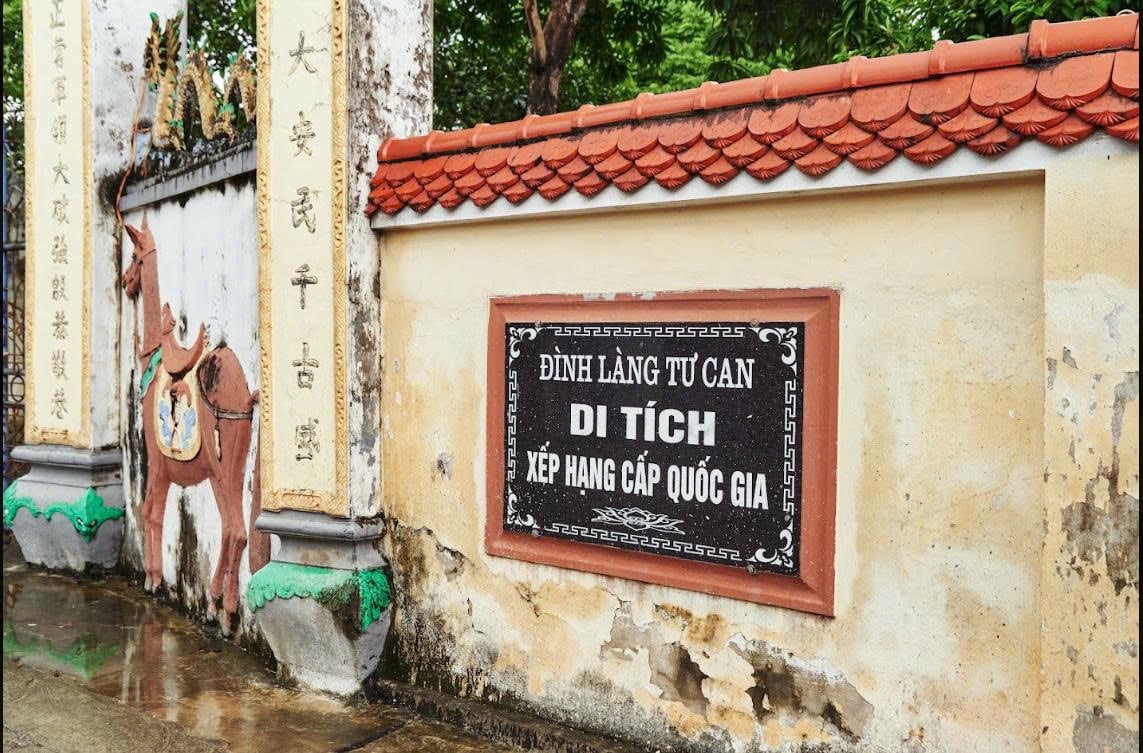
Tu Can Communal House is located in the old Tu Can village, now in Chau Can Hamlet, Chuyen My Commune, Hanoi City. Before July 1, 2025, the address of the communal house was recorded as Tu Can Hamlet, Chau Can Commune, Phu Xuyen District. The communal house stands on a central plot of the village, faces northwest, and has a pond in front.
The communal house worships Great King Dong Bang, with the honorific title Hung Tran Duc Bao Trung Hung Dong Bang Ton Than. According to the legend, he was the son of Lac Hau General Truong Cong Khoa and Mrs. Pham Thi Hoa, and he helped Phu Dong Thien Vuong fight the An invaders. After his death, he was honored by the people of Tu Can as the village tutelary deity and worshipped at the communal house. This is a legend preserved in the local religious life.
The communal house has a Dinh-character-shaped floor plan, consisting of the main hall and the rear shrine. The main hall has three bays and two side aisles, with gable end walls; the wooden frame is set on four rows of columns. The roof trusses are made in the gia chien and chong ruong styles, combined with ke and bay. The rear shrine is attached behind and is where the altar to the tutelary deity is placed.
On the wooden structures, many carved panels in the artistic style of the 18th century remain. Notable are dragons with open mouths holding pearls, with long blade-like motifs extending backward. The ceremonial gate and the system of ornamental pillars are decorated with four phoenixes, four sacred creatures, four noble plants, Chinese-character couplets, and the motif of a bat holding the character “phuc” (fortune).
The relic site still preserves seven incense tables, one worship platform, a dragon throne and spirit tablet, a Tho Ha ceramic incense bowl, one genealogical record, and five royal edicts from the Tu Duc to Khai Dinh reigns. These are documents and artifacts associated with the history of worshipping the tutelary deity and the existence of Tu Can village.
Every year, the villagers hold ceremonies on the 12th day of the first lunar month, the 12th day of the fifth lunar month, the 12th day of the eighth lunar month, and the 12th day of the eleventh lunar month; the 12th day of the eighth lunar month is the main ceremony. On July 17, 2008, the Ministry of Culture, Sports and Tourism ranked Tu Can Communal House as a national architectural and artistic relic under Decision No. 57/2008/QĐ-BVHTTDL.



