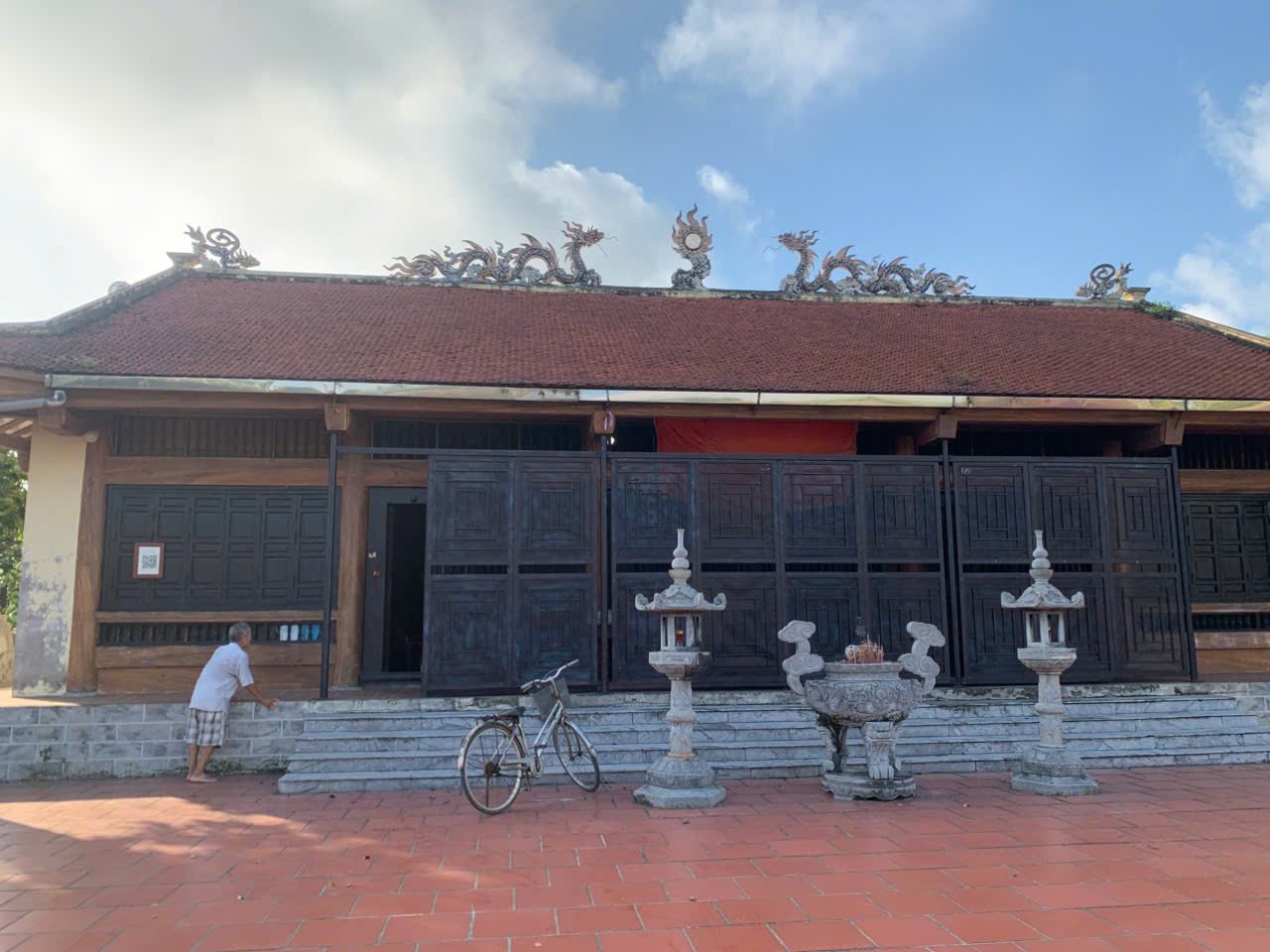
Tu La Communal House, Phu Yen Village, Hoa Phu Commune, Hanoi City
Introduction
Tu La Communal House is a traditional Vietnamese folk architectural work, where the two village tutelary deities Do Luong Dai Vuong and Chieu Linh Princess are worshipped - people who rendered merits to the people and the country during the Ngo Dynasty.
Regarding the deity Do Luong Dai Vuong, he was the second son of Mr. Do Tung and Mrs. Vi Thi Hoa; he followed his uncle to join Ngo Quyen's army. He bravely killed the enemy general Hoang Thao, contributing with our army and people to crushing the Southern Han army. When Ngo Quyen ascended the throne, to maintain diplomacy, the king sent him as an envoy to Southern Han. Because he refused to submit in enemy territory, he was beheaded by the Southern Han king and put in a box and set adrift on the river; his body drifted along the current to the Day River. Ngo Vuong Quyen deeply regretted him because he had great merits, so he conferred on him the title of Phuc Than and had 57 villages build temples to worship him, including the old Tu La village, with the 6th day of the 11th lunar month as his death anniversary.
Tu La Communal House is an architectural work with a layout in the shape of the character Nhi, comprising the Dai Bai main hall in front and, behind it, the Hau Cung rear shrine built at a distance from Dai Bai across a small ceremonial yard.
- The Dai Bai of the communal house is built in the style of closed gable walls with tay ngau, two sloping roofs, ridge, roof slopes and nail borders; at both ends of the ridge are two simple ridge blocks. The tay ngai are two square-section bronze pillars; on the pillar tops are stylized four phoenixes facing a flower, symbolizing the spiritual cosmic axis between the earthly world and the deities.
- From Dai Bai, crossing a small ceremonial yard leads to the Hau Cung of the communal house. The Hau Cung is a three-bay horizontal building with closed gable brick walls; inside, the ceiling is vaulted, influenced by French architecture in the early 20th century. In the Hau Cung, three altars of different heights are built, of which the central altar is where three dragon thrones are placed with three statues: in the middle is the statue of Do Luong, on the left is the statue of Chieu Linh Princess, on the right is the statue of Duke Chu Xuan Han; the three statues are carved quite intricately in the sculpture style of the Nguyen Dynasty.
Tu La Communal House is a place of worship for the two Tutelary Deities and a co-worshipped deity who rendered merits to the people. The communal house still preserves a number of valuable artifacts. It is also a venue for political and cultural meetings of mass organizations in the village and a place to educate younger generations about love for their homeland and country and to follow the example of their predecessors.