
Vien Noi Communal House
Story
01VIEN NOI COMMUNAL HOUSE RELIC
The Vien Noi Communal House Relic is located in Vien Noi Village, former Van Noi Commune, now in Phuc Thinh Commune, Hanoi City.
This is an ancient land with a long history tied to the expansion of the country by the Hung Kings. By the reign of King An Duong Vuong, with the capital at Co Loa, former Van Noi lay within the protective belt of Au Lac. Vien Noi bears many traces of the Trung Sisters’ uprising in the early years of the Common Era. In the pre-uprising period (1941–1945), Vien Noi was a bright spot of the Central ATK, where the printing office of the newspaper “Liberation Flag” was located and where the directive “The Japanese and French Fire at Each Other and Our Actions” was drafted, contributing to the overall victory of the August Revolution in 1945.
According to the genealogy and relics still preserved, Vien Noi Communal House was built during the Le Dynasty. After several renovations that retained its architecture, it was destroyed in 1948. In 1994, the rear hall was restored. In 2004, the front hall was renovated, and the architecture has been preserved to the present.
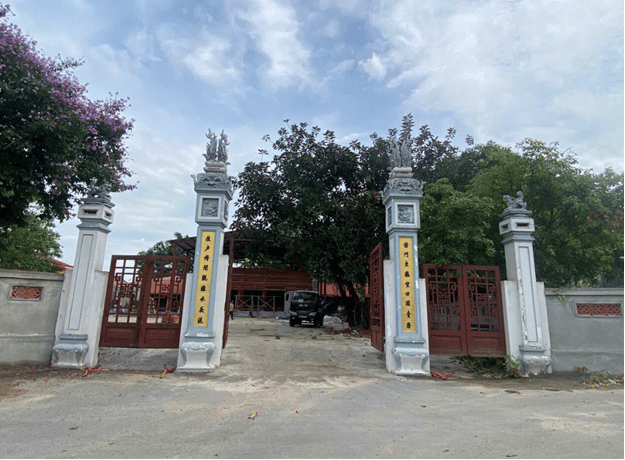
Vien Noi Communal House was built facing west in the center of Vien Noi Village, on a large and spacious plot. In front of the communal house gate is the village sports field; the communal house courtyard is large and paved with bricks. Perennial trees are planted around the communal house, covering an area of nearly 2,000 m².
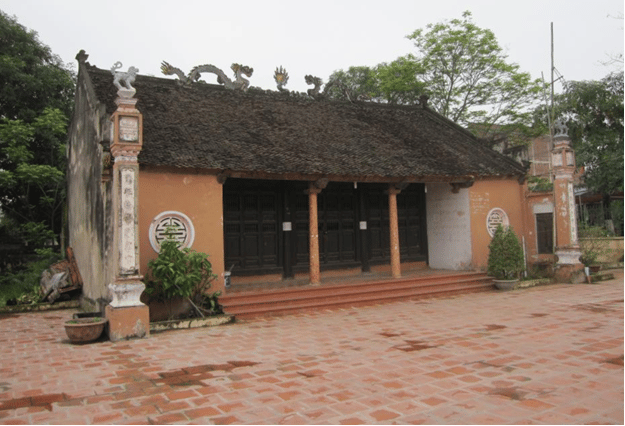
The communal house’s ceremonial gate is built in a fairly simple four-pillar style, consisting of 2 large pillars and 2 small pillars, opening 3 entrances into the communal house space. The main communal house has a ground plan with the front in the character “one”, and the rear in the character 'ding'. The front hall consists of five bays with a closed gable end, and the handrail has a pillar inscription. The three central bays are recessed to create a porch, fitted with folding panel doors in the upper-lattice, lower-panel style. The two side bays have walls with windows shaped like the character “thọ”, the roof is covered with traditional tiles, the floor is paved with bricks, and the roof ridge is decorated with a dragon facing the sun. The architectural decoration is simple, mainly moldings, flowers and leaves, and the four seasons, with some patterns and chrysanthemum leaves in the two end bays.
The central hall architecture is of the closed gable type with a wooden frame, roofed with traditional tiles, brick-paved floor, and a structure of gá chiêng and quá giang beams. Between the front hall and central hall there is a concrete roof section replacing the drainage trough. The rear hall consists of one bay and one longitudinal aisle connected to the central hall, built in the closed gable style, roofed with traditional tiles, and brick-paved. In the most important position in the central bay is the altar base, on which are placed the dragon throne and the tablet of the village tutelary god, crafted in the artistic style of the 19th century. Below are arranged a bronze five-piece altar set, flower vases, ceramic incense bowls, water stands, and a box for storing royal edicts.
To the left of the main altar is a throne containing “Ong Qua” lacquered and gilded, used in the early-year Cau Ball-Grabbing Festival.
According to the sacred genealogy preserved at the relic, Vien Noi Communal House worships two village tutelary gods, Dong Bang and Uong Ta, two brothers who helped Tan Vien Son Thanh defeat the Thuc army in the area of Vien Noi, Kinh Bac region.
After winning the battle and returning to court, Son Thanh submitted a report to King Hung Due Vuong: “At that time, when the soldiers stopped at Vien Noi, Kinh Bac region, they saw two deities appear and, following the army, rush out to fight the Thuc army and achieve great merit.” King Hung Due Vuong conferred titles on the two deities: one was Dong Bang Pho Te Ho Quoc Hien Ung Am Phu Anh Linh Dai Vuong, and the other was Uong Ta Pho Te Ho Quoc Hien Ung Am Phu Anh Linh Dai Vuong. From then on, the deities were very efficacious, so many generations of kings bestowed beautiful titles: Ban Canh Thanh Hoang Pho Hoa Phu To Dung Duoc Linh Thong Dai Vuong, Dai Duc Phu Van Cuong Nghi Anh Linh Dai Vuong, and granted Vien Noi the right to establish a temple for worship.
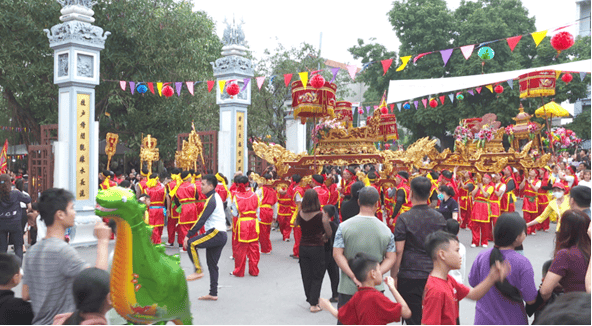
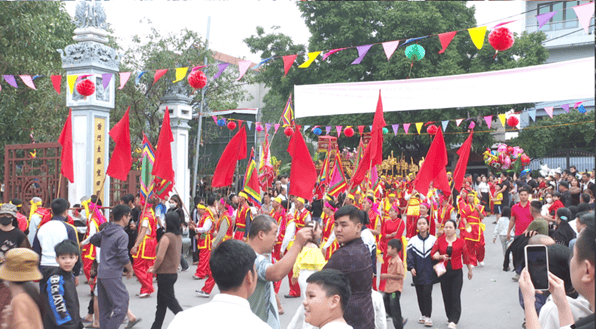
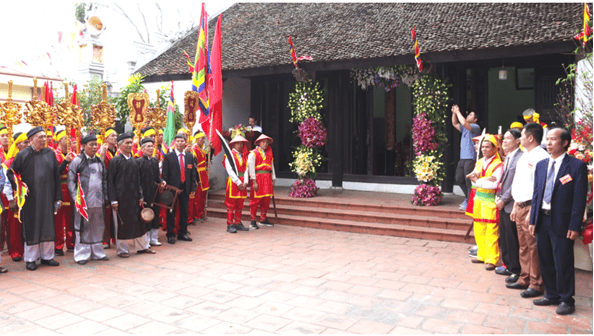
Every year, the people organize a festival to express gratitude for the merits of the Saint, including a procession of Ong Qua – Ball Grabbing, recalling the legend of Tan Vien Son Thanh, with the help of the two village tutelary gods, cutting off the enemy general’s head and bringing peace to the country.
Vien Noi Communal House was ranked as a City-level Historical and Artistic Relic under Decision No. 488/QĐ-UBND dated January 19, 2012.



