1. Formation and development process
Vinh An Communal House belongs to Thanh Binh Hamlet, Hong Son Commune, Hanoi City. According to the accounts of village elders and artifacts still kept at the relic, the communal house was founded during the Le Dynasty, around 1460. Initially, it was only a small communal house built of bamboo and trellis near the river, where local people worshipped the village tutelary god and practiced traditional religious rituals.
In 1906, due to changes in natural conditions and the community's need for religious activities, the people moved the communal house to its current location, about 300 m from the old foundation, and rebuilt it on a more spacious scale. The communal house is located in the center of the village, on the inter-village road, facing South. The relic has a spacious, airy space, surrounded by the road system and fields of the former Vinh An Village, creating a harmonious landscape rich in the typical features of a traditional Northern Delta village.
Vinh An Communal House is the place of worship for three village tutelary deities: Bach Quoc Minh, Bach Quoc Hung, and Bach Quoc Cuong. According to local legend, the three were people who had merit in defeating invaders and saving the country, protecting the homeland, and also gathering people to establish hamlets, reclaiming land and stabilizing life for the people. After they passed away, to remember their great contributions, the people built a communal house to worship them and honored them as village tutelary deities. The belief in worshipping the three tutelary deities expresses the moral principle of 'When drinking water, remember its source,' the tradition of gratitude to predecessors who had merit with the people and the country, and also reflects the beauty in the cultural and religious life of residents in the Northern Delta.
2. Historical value
During the revolutionary struggle, Vinh An Communal House was also associated with many local historical events. During the August Revolution of 1945, the communal house was used as a place to detain criminals. In particular, during the resistance war against the Americans for national salvation, in 1972, Mr. Nguyen Van Quan - a local resident - participated in surrounding and capturing an American pilot who fell in the Hang Coc Mountain area. He was the first person to face him and forced the pilot, Captain Mashesl, to raise his hands in surrender, and was awarded a certificate of merit by the State for this achievement.
3. Relic ranking
Not only does it have historical and artistic architectural value, Vinh An Communal House is also a place where local traditional religious activities and festivals take place, contributing to community cohesion, educating patriotic tradition, solidarity, and the moral principle of 'When drinking water, remember its source,' while preserving and promoting national cultural identity. The relic also preserves many tangible and intangible cultural values tied to the formation and development of Vinh An Village over many centuries.
With its outstanding historical, cultural, artistic architectural, and religious values, Vinh An Communal House was ranked by the Hanoi City People's Committee as a city-level Historical-Cultural Relic under Decision No. 1168/QD-UBND dated February 28, 2025. The ranking is an important basis for preserving and promoting the relic's values, contributing to safeguarding traditional cultural identity and educating present and future generations about the history and fine traditions of the homeland.
4. Artistic architecture
The relic has an architectural layout in the shape of the character 'Dinh,' including main items such as the communal house gate, Dai Bai hall, Trung Cung, Hau Cung, along with the communal yard, well, and auxiliary works serving religious activities. Through many repairs and renovations, the communal house still maintains its role as an important religious architectural work and a cultural activity center of the local community.
4.1. Gate:
The gate is the first item located close to the inter-village road, simply built with two main pillars; the tops are decorated with four phoenixes facing the body, tails converging toward the sky, heads turned in four directions. Below is a square lantern compartment decorated with patterns; the pillar bodies have raised edges and lines and are decorated with pairs of Chinese-character couplets; the bases are in a gourd-shaped constricted form. Connecting to both sides is the wall system surrounding the relic.
4.2. Dai Bai hall:
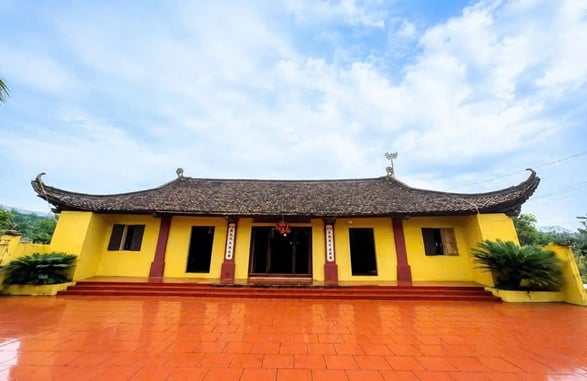
From the gate, through a yard paved with red square bricks measuring 30x30 cm, is the Dai Bai item; stepping up three brick-paved steps leads to the Dai Bai porch. The porch is wide and airy.
Dai Bai is a work with three bays and two wings, with an architectural structure of four curved knife-edge roofs, covered with traditional tiles. In the middle of the ridge is left plain without decorative patterns. At the two gable ends are attached kìm figures; the ridge bands run long and curve down to the roof corners. The three central bays have three doors leading inside; the doors are made of wood, painted dark brown, simple without decorative patterns. The two wing bays are closed at the front and opened with two ventilated windows.
Inside, corresponding to the bays, are four sets of wooden roof trusses: the two sets in the central bays are uniformly made in the 'Thuong gia chieng, ha con' style on four rows of feet with one row of outer columns. On the trusses and panels are decorations of dragons, phoenixes, clouds, etc.
The two gable-end trusses are made in the 'Thuong gia chieng, ha ke xo' style. The trusses are smoothly planed and carved with some decorative motifs.
The Dai Bai item is arranged with two horizontal plaques of Nguyen Dynasty value.
4.3. Trung Cung
Trung Cung is an item newly renovated by the people in recent years. Originally it was an open yard, left empty and airy.
Trung Cung is an item located behind Dai Bai with five bays, covered with a metal roof; the iron trusses are simple 'vi keo' trusses.
In the Trung Cung item, a main altar is arranged in the center, including an incense table, on which are placed an incense bowl, candlesticks, an incense tube, a fruit tray, etc. In front of the altar is a set of bat buu. In the side bay, three palanquin sets are arranged...
4.4. Hau Cung:
Connecting from the central bay of Trung Cung is the Hau Cung item. Hau Cung is made in the 'Tien dao hau doc' style, roofed with traditional tiles, and floored with red square bricks. Stepping up about 20 cm leads to the Hau Cung porch. Hau Cung is made in two parts; the porch part is wide and airy, with trusses made in the 'Chong ruong gia chieng, con hien' style. On the trusses and panels are decorative patterns, dragons, etc.
The Hau Cung porch is arranged with a main altar in the center, including an incense table on which are placed worship objects such as an incense bowl, candlesticks, an incense tube, a water vessel, and a set of bat buu...
Through the door into the inside, the door is made of hinged wood. The trusses are made in the following styles: the central truss is made in the 'Thuong con, ha ke ngoi' style, and the gable truss is made in the 'Thuong gia chieng, ha ke ngoi' style. The trusses are smoothly planed and tightly joined, leaning toward durability.
Here, a main altar is arranged in the center, including: above is a horizontal plaque and a brick altar base; on it are placed a fruit tray, a water vessel, candlesticks, an incense bowl, a long throne, worship statues, a scripture stand, a box of edicts, a bronze bell, a tablet, etc. On both sides of the columns are a pair of trough-shaped couplets, and in the center is a curtain door.
5. Religious activities related to the relic
The festival is a community religious cultural activity that binds villagers together, brings people closer, reminds them of their ancestral roots, and is also an occasion for people to compete in skill and enjoy entertainment after hard working days. The festival dates from the reign of King Le Thanh Tong (1460-1497) and is held mainly on the 9th, 10th, and 11th days of the second lunar month. During the resistance wars against the French and the Americans, Vinh An was a white belt area, so the festival was not held. In 1993, the festival was restored. The festival is held on the 9th, 10th, and 11th days of the second lunar month, with a major celebration every five years; annually, only an incense-offering ceremony in memory is held on site according to traditional rituals.
According to accounts of village elders and the genealogy 'Le Thanh Tong trieu cong than tam vi pha luc,' Vinh An Communal House worships the three tutelary deities Bach Quoc Minh, Bach Quoc Hung, and Bach Quoc Cuong, who had merit in defeating invaders, saving the country, and gathering people to establish hamlets.
Through the festival, the spirit of community solidarity among the people has been spread, remembering contributions and educating the tradition of 'When drinking water, remember its source' of the villagers toward the saints. Thereby, it contributes to propagating and raising awareness and responsibility of officials and people in practicing, respecting, preserving, and promoting heritage values, while building the great unity bloc of the whole people and building a new cultural lifestyle in residential areas.
With outstanding historical, cultural, scientific, and aesthetic values, associated with the formation and development of former Vinh An Village and the patriotic and solidarity traditions of the local resident community, the relic is not only a place of worship for the three village tutelary deities Bach Quoc Minh, Bach Quoc Hung, and Bach Quoc Cuong, but also a cultural and religious activity center, a place preserving traditional festivals, customs, and practices and educating the moral principle of 'When drinking water, remember its source' for generations. With its system of artifacts, edicts, genealogies, and traditional architecture carrying artistic value, the communal house is a valuable source of material for research on history, culture, fine arts, and folk beliefs. Those values affirm the important role of Vinh An Communal House in preserving national cultural identity, contributing to educating tradition, consolidating community unity, and promoting cultural heritage values in the cause of building and developing the homeland.




