
Y SON COMMUNAL HOUSE
Introduction
Nui Y Son Village, Dong Mai Commune, Thanh Oai District, old Ha Tay Province, now residential groups 28, 29, and 30 of Yen Nghia Ward, Hanoi City, has a long-standing relic that is the community cultural center for all the people of Nui Y Son Village. According to the elders, the traces of the old communal house are at Quan Ha Temple today. Before 1936, villagers moved it to the current communal house site. In 1936, villagers restored it and named it Y Son Communal House. As of July 1, 2026, under the Party and State policy of merging residential groups, Y Son Communal House relic has a new address at Nhan Son Residential Group, Yen Nghia Ward, Hanoi City.
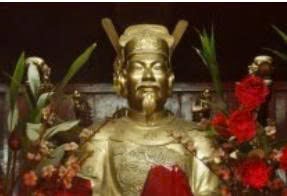
To remember the great merits of Saint Bo Cai Dai Vuong Phung Hung, Nui Y Son Village has worshipped him since ancient times. In 2013, officials, elders of both sexes, and sectors and organizations mobilized villagers and pilgrims to donate to cast a statue of the saint from a single block of red bronze weighing nearly 700 kg, along with 9 chi of real gold to gild the throne, hat, robe, and imperial robe.
The enthronement and inauguration ceremony took place on the occasion of the 1,225th anniversary of the saint's death on August 13 of the Quy Ty year (2013); the stele was completed in April of the At Mui year, 2015.
King Phung Hung was born on November 25 of the Canh Ty year in Cam Lam Village, Duong Lam District, Son Tay Commandery (now Duong Lam Commune, Son Tay Town).
His father was Phung Hap Khanh, a kind and virtuous man who had taken part in Mai Thuc Loan's uprising in 722 in Thien Loc (Ha Tinh), then returned to his homeland with his wife, a woman of the Su family. The couple worked hard and became wealthy. Because they were compassionate and always helped the poor, cultivating virtue, they had three sons: Phung Hung, Phung Hai, and Phung Dinh, three handsome brothers who understood astronomy above and geography below.
Phung Hung was accomplished in both letters and martial arts and had extraordinary strength: he could wrestle buffaloes and fight tigers. It is said that once he subdued two wild buffaloes, and another time he brought down a fierce tiger that was harming the people. His brother Phung Hai had superhuman strength, and everyone who heard of him admired and respected him. His youngest brother, Phung Dinh, was no less than his two brothers; he also had extraordinary strength and was accomplished in both letters and martial arts.
In the second year of the Dali era of the Tang dynasty (767), Cao Chinh Binh, a Tang official, came to rule Vietnam. He implemented harsh rule, plundered property, imposed heavy taxes, and used cruel and brutal punishments, causing the people to suffer and everyone to resent him. Phung Hung raised the banner of uprising, recruited troops, and welcomed talented people to fight the enemy and save the country. He was trusted and supported by the people. In only a short time, his soldiers numbered tens of thousands. Wherever he went, the people responded and followed him, and before long his soldiers became a powerful force. He trained troops while joining his brothers in leading soldiers to guard key areas to facilitate direction of the uprising. Phung Hung changed his name to Cu Lao and styled himself Do Quan; Phung Hai changed his name to Cu Luc and styled himself Do Bao; Phung Dinh styled himself Do Thong. The three brothers and generals such as Thien An, Thien Cu, Do Nhung, Lanh Binh, Luc Thanh, Luc Kieu, Ha Trai, Bo Pha Cau, Do Anh Han divided among themselves to guard nearby areas.
On February 12 of the Tan Dau year (781), the King held a grand flag ceremony to launch the troops at the headquarters on Linh Han Hill in Khuc Giang village (now Trieu Khuc Village).
From here, the King divided the main army into six directions advancing to the provincial citadel. At the end of the 8th century, in the Tan Mui year (791), the opportunity came; Do Anh Han, one of his famous generals, proposed a plan to besiege Tong Binh Citadel. Phung Hung followed it and decided to send troops in several columns and routes from Son Tay, suddenly advancing on Tong Binh Citadel (present-day Hanoi). Phung Hung directed the two armies of Ong Thi and Ong Dien to station east of the citadel to block the enemy's retreat. Cao Chinh Binh brought 40,000 troops out to fight. With the fierce fighting spirit of the insurgents and talented commanders, Phung Hung led the main army into battle; wherever the insurgents went, the enemy scattered, and the panicked enemy had to retreat into the citadel to defend. Cao Chinh Binh commanded more than 40,000 officers and soldiers to resist. The battle lasted seven days and nights; our troops fought very bravely, and countless enemy soldiers died, their blood reddening stretches of the Nhi Ha and To Lich rivers. The enemy's spirit was confused and chaotic. Cao Chinh Binh hurriedly drove the remnants into Tong Binh citadel. The King immediately ordered troops to surround and attack the citadel from eight sides. Cao Chinh Binh, fearful and resentful, fell ill in his back and died; the remaining enemy had to open the citadel gates and surrender. Phung Hung's insurgents pressed the advantage, surrounded all four sides, and attacked fiercely. The enemy could not resist, corpses lay everywhere, and the remnants fled; Cao Chinh Binh committed suicide, Phung Hung captured the citadel, and our army won a great victory.
The King led his troops into the citadel, comforted and pacified the people, and repaired the palaces, towers, and fortifications. On the 10th day of the first lunar month of the Nham Tuat year (782), the King held a grand enthronement ceremony and ascended the throne. Soldiers and people in the citadel cheered and shouted: Long live. From then on, the people enjoyed peace and happiness, ending a long dark period.
In 791, Phung Hung came to power and ruled the country, and the people enjoyed peace. After seven years, he died on August 13 of the Nham Ngo year (802) at the age of 41. People throughout the country mourned him deeply.
After the King passed away, the people enthroned his son Phung An as Do Phu Quan. Phung An posthumously honored his father as 'Bo Cai Dai Vuong', because according to national custom, father is called 'Bo' and mother 'Cai', hence the title. Phung An reigned for 3 years. In July of the Tan Mui year (791), Emperor Dezong of Tang sent Trieu Xuong to serve as Protector General of Annam. Upon arrival, Trieu Xuong first sent envoys with gifts to persuade Phung An. Facing a strong and ferocious enemy and knowing our troops could not resist, to avoid further bloodshed for soldiers and people, Phung An had to surrender. From then on, our people all had to become vassals of the northerners.
Soon after the King died, he became spiritually manifest; he often appeared in the countryside, taking the form of thousands of chariots and horses, flying over rooftops and ancient trees, with the sounds of flags, drums, and palanquins clearly heard in broad daylight.
It is also said that during his lifetime, remembering his father the King's merits, Phung An sent virtuous officials to find places with traces of his father to establish temples for worship.
After his death, he was brought to Trai Tau Ma west of Tong Binh Prefecture, now Kim Ma Ward, Ba Dinh District, Hanoi. Beside his tomb, a couplet was inscribed with the following content:
Tang nhan ky huu, Tam hoa ngac, Lien huy than hau, Thuyen vo huyen vu giap.
Han tac ha tuc sy, Thao mao xuong nghia sinh tien so luc lam binh.
Rough translation:
The Tang people should be ashamed before us brothers; in later generations, no one will bow their head to be a slave.
The Han invaders know no shame; even grass and trees rise up; while our generation lives, our people will rise like a forest.
Legend says that after his death, Phung Hung was very spiritually powerful; he often appeared to help people in distress and secretly aided Ngo Quyen in defeating the Han invaders on the Bach Dang River, so the people established temples to him in many places.
Phung Hung was a national hero who drove out the Tang colonial administrators and won autonomy for the country. After his death, he was honored as a father and mother of the people (Bo Cai Dai Vuong). People in many places established temples to worship him, such as Duong Lam (Son Tay, Ha Tay), Kim Ma (Ba Dinh, Hanoi), Quang Ba Village, Quang An Commune (Tay Ho District, Hanoi), Trieu Khuc (Ha Dong, Ha Tay), Phuong Trung (Thanh Oai, Ha Tay), and Y Son Village (Dong Mai Commune, Thanh Oai District, Ha Tay Province).
Y Son Communal House is located on a high, beautiful plot in Nui Y Son Village, facing due south. To its right is the large Day River flowing through Thanh Oai District, Ha Tay Province, now Nhan Son Residential Group, Yen Nghia Ward, Hanoi City. Around the communal house is a densely populated residential area, creating the warm scenery of a traditional Vietnamese village.
According to the elders in the village and some remaining relics such as stone column bases, Y Son Communal House was once grand for the Thanh Oai area, consisting of a Great Hall with three bays and two side wings and four curved roofs. However, due to time and destruction by war, the old communal house no longer exists. To continue the tradition of their ancestors and remember the source when drinking water, the people rebuilt the communal house on the old foundation. At present, the main items of the communal house include: the Nghi Mon gate, the screen, the Great Hall, the Rear Palace, and the courtyard and garden system.
From the road, the first item we encounter is the Nghi Mon gate. The Nghi Mon of Y Son Communal House is built in the style of ceremonial pillars with three passages. The main passage has two massive ceremonial pillars, on top of which are reliefs of four phoenixes adoring stylized flowers. The phoenix here is a sacred creature representing the upper realm as prescribed in traditional Vietnamese art: its head wears a crown of justice, its eyes are the sun and moon, its back carries the sky, its tail is the constellations, its wings are wind, its feet are earth, and its feathers are trees and grass. Thus the phoenix symbolizes the universe and the movement of the sky linked to the saint's transmission of power. The phoenix standing on the ceremonial pillar represents the yin-yang axis and the cosmic axis, connecting the earthly world with the spiritual world and bringing vital energy from Father Heaven down to Mother Earth. Next is the tiger amulet panel, with four dragon heads extending majestically in four directions at its four corners. Below is a four-sided lantern box with raised decorative lines; inside the lantern box, the four sacred creatures are molded in lime mortar (the four sacred animals: Dragon, Unicorn, Turtle, and Phoenix). The pillar bodies bear Han-character couplets praising the communal house's landscape and the local tutelary god's merits. Between the two large pillars and two small pillars are two passages made as small four-roofed cannon gates. Connected to the cannon gates on both sides are two small ceremonial pillars. These two pillars are simpler than the large ones; on top are a pair of kneeling nghe creatures, meaning to control the spirituality of pilgrims before they worship the saint. A protective wall is built around them.
Passing through the Nghi Mon, the first item we encounter is a screen built of brick and lime mortar with two pillars on either side, intended to block impure things from entering the relic. The screen is as wide as the central bay of the Great Hall and is shaped like a scroll; on the inner face, in the center, is a relief of a dragon rolling water, with two longevity characters on either side. The outer face has reliefs of plants and a tiger. The two ceremonial pillars on either side have square cross-sections and bear pairs of Han-character couplets.
From the screen, passing through a large courtyard paved with old bat-shaped bricks, we reach Y Son Communal House, built in the shape of the character 'nhi' (=), consisting of two buildings: the Great Hall and the Rear Palace. On the roof is the ridgepole.
The Rear Palace of Y Son Communal House is a three-bay transverse building; from outside, the ridge and sloping edges are built with communal-house edges, the ends of the ridge are decorated with dovetail motifs, and the gable walls are closed with two sloping roofs covered in ri tiles. Inside, corresponding to the three bays are four roof-supporting trusses on a plan of four rows of column bases. The roof-supporting trusses of the Rear Palace are all made in the same style: rafter-and-beam truss style simple, favoring durability and openness for the saint-worship space.
The top tier is 160 cm high, 99 cm wide, and 94 cm long, where the dragon throne and memorial tablet are placed.
The second tier is 115 cm high, 203 cm wide, and 89 cm long, where the royal edicts, hagiography, and ritual texts are placed, etc.
The third tier is 79 cm high, 203 cm wide, and 98 cm long, where the incense bowl, water vessel set, and some other ritual objects are placed.
In summary, although Y Son Communal House is not a large and massive communal house like some others, it brings together a full traditional architecture. The art of carving on the wooden architecture is notable in the wooden brackets carved in relief on both sides with images of dragon rolling water, the four sacred creatures (Dragon, Unicorn, Turtle, Phoenix), tiger amulets, and chrysanthemum vines. The intricate, meticulous craftsmanship in the 19th-century style has contributed significantly to the tangible cultural heritage of the homeland and the province.



