
Yen Noi Communal House
Introduction
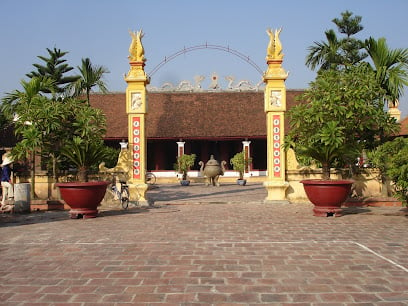
Yen Noi Communal House was built around the Le Trung Hung period and worships Bach Hac Tam Giang, a famous water deity in the books Viet Dien U Linh and Linh Nam Chich Quai. The communal house still preserves many royal edicts; the first was recorded in the 10th year of Hoang Dinh (1610) under the reign of King Le Kinh Tong, and the last was recorded in the 9th year of Khai Dinh (1924). The communal house underwent several restorations in 1797, 1915, 1934, and 1989.
The communal house currently bears the artistic architectural style of the late Nguyen period. The outer three-entrance gate consists of four large pillars opening onto the village road to the east, with a semicircular pond on the other side of the road. Behind the gate is a large brick courtyard, while the inner three-entrance gate consists of only two small pillars. The layout follows the shape of the character Cong; on both sides of the inner courtyard are two small side halls; the main hall consists of five bays and connects to the rear sanctuary in the shape of a hammer handle.
Inside the communal house, there are many highly valuable wood carvings with themes of the four sacred creatures and floral and plant motifs. The worship objects in the communal house include deity records, royal edicts, horizontal boards, couplets, incense tables, stone steles, a palanquin set, and eight treasures. Tradition has it that, besides the stone stele, there was also a bell to which Princess Tuc Trinh contributed money for casting, accompanied by her testament. This bell was once stolen, but later the villagers donated funds and recast it together with the testament.



