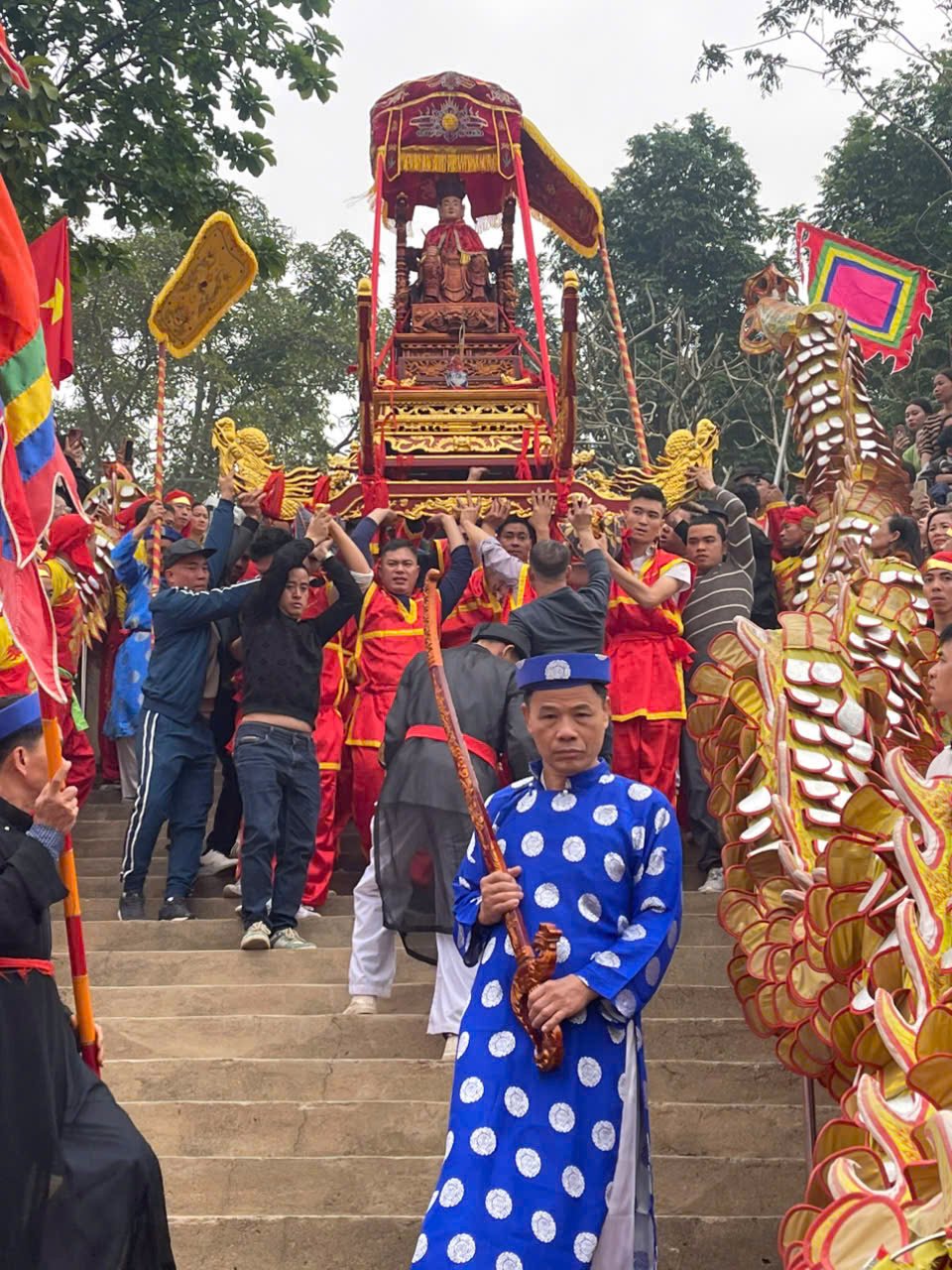
Traditional festival of Luu Xa communal house, Luu Hoang village, Hoa Phu commune, Hanoi city
Introduction
According to the 1938 divine genealogy and deity title records of Luu Xa village, Hoang Xa village, Hoang Luu canton, Chuong My district, Ha Dong province, now archived at the Library of Social Sciences (Vietnam Academy of Social Sciences), Linh Lang's birthday is the 16th day of the first lunar month, with customary singing and three days of boat racing (rowing contests), and a procession of the deity's tablet at the river confluence (Tha confluence). The deity's transformation day is the 10th day of the second lunar month, also marked by a procession of the deity's tablet at the river confluence, boat racing (rowing contests), and three days of singing.
An old legend recounts that when the Royal Consort married King Ly Thanh Tong and had no child, one day after her parents died she returned to mourn them. On her way back to the capital, the Royal Consort passed West Lake and went down to bathe before entering court; then a giao long appeared, wrapped tightly around her, and made her faint. Her maids brought her back to the capital, but she was unconscious for a whole week. After that she became pregnant and gave birth to Linh Lang Dai Vuong. When Linh Lang was small, the Chinh Vinh (Song) invaders came to invade; the king called for assistants and sent envoys to negotiate. When he heard this, he told the envoys to go back and prepare elephants and ten-meter flags, and he would defeat the enemy. He went to battle and won a complete victory on the Cau River, after which he recruited two men, Le Cong Bao and Pham Cong Hoang.
The local people, knowing the merits of the four supremely sacred deities, built a communal house here for worship.
The festival is held mainly at Luu Xa communal house, with a palanquin procession from the communal house to Quan Thuong, a remote worship site about 1 km away, and the escort of the Holy Mother statue from the Mother Temple next to the communal house to attend the festival. Along with the country's historical upheavals, the communal house was burned by the French, occupied as a residence, and a Luu Xa military post was built; the villagers had to move the worship objects to the shrine at the head of the village to worship the tutelary deity. After 1954, the villagers moved the worship objects back to the communal house's old land and gradually rebuilt the communal house. In 2007, the communal house was restored and inaugurated in 2008.
Land palanquin procession and waterborne palanquin procession.
- Day 14: prepare offerings and equipment, and set up the palanquins.
- Morning of day 15: ceremony to open the royal edict; offerings include glutinous rice, chicken, incense and flowers, and oan fruit cakes; the ceremony is held in the communal house courtyard.
- Afternoon of day 15: opening of the festival, organizing a procession of 05 deity palanquins and 01 Uncle Ho palanquin from the communal house throughout Luu Xa village territory along the two main roads, the Day dike road and provincial road 419. After that, the palanquins stay at Quan Thuong; the female ritual officiating team (elderly women) will perform the respectful ceremony, and the palanquins stay at Quan Thuong overnight.
- Evening of day 15: cultural exchange performance night.
- Morning of day 16: carry the deities from Quan Thuong down to the Bui River wharf, travel by motorboat to Tam Giang wharf (in front of Luu Xa communal house), and the boats circle around the wharf for about an hour. Meanwhile, there are 02 rowing and boat teams (male and female) rowing around the boats carrying the deities' palanquins; the people call this ritual rowing, with the role of protecting the deities, like two elite armies, and also serving as rescue if someone accidentally falls into the river. After one hour, the palanquins are carried up to the communal house and a communal ceremony is held there.
- In addition, boats go to welcome the palanquins of Hoang Xa village and Phu Yen village (former Vien An commune); the two villages are sworn brother villages and jointly welcome them to attend the festival.
- Afternoon of day 16: incense offering ceremony at the communal house.
- Morning of day 17: thanksgiving ceremony and closing of the communal house.
The festival organizes several activities such as: boat racing, human chess, and climbing a bridge to smash pots.
+ Boat racing: young men and women compete in boat racing at the confluence of the Day River and Bui River, demonstrating solidarity.
+ Human chess: chess pieces are drawn on the yard and matches are organized.
+ Climbing a bridge to smash pots: a bridge is suspended over the river and a pot is hung at the bridgehead; players must keep their balance on a bamboo pole used as a bridge to advance and kick the hung pot.