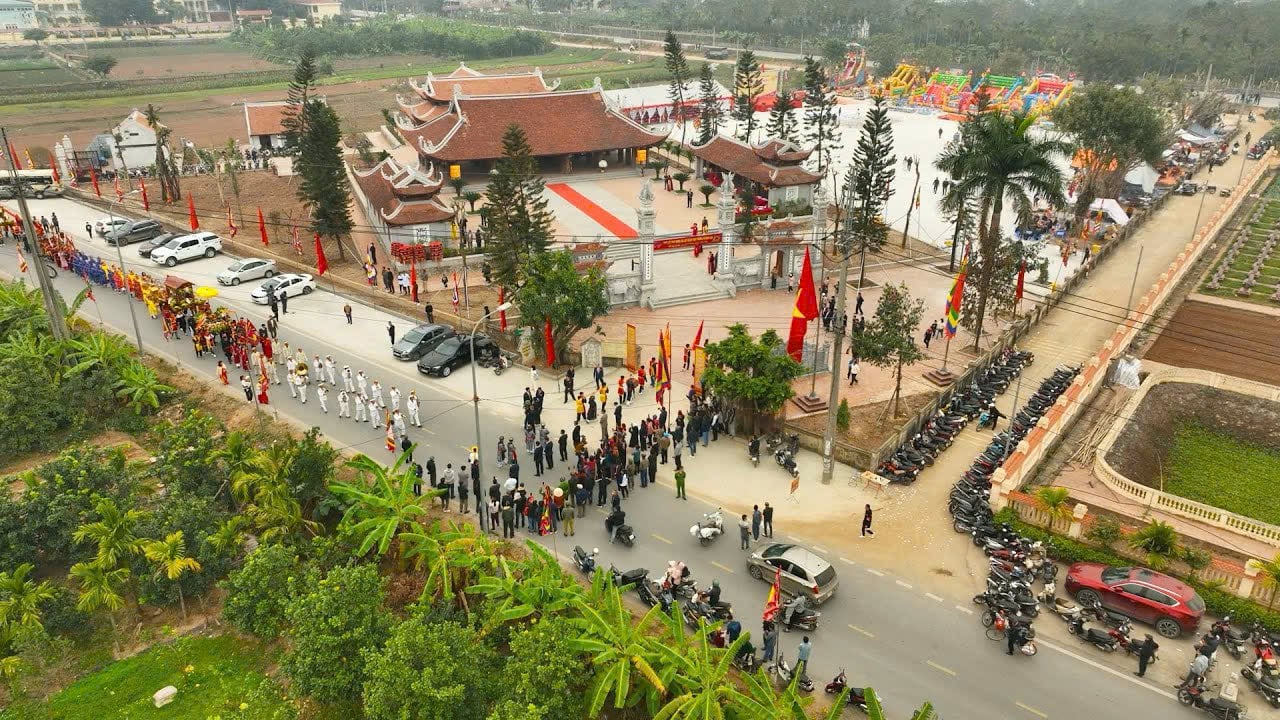
The traditional festival of Van Coc Communal House is held annually to remember and express gratitude for the great merits of the Three Tutelary Deities, including three outstanding female generals: Phung A Tu, Phung A Huyen, and Hoang Thuong Cat. During the Trung Sisters' uprising against the invading Eastern Han, the three generals achieved many glorious victories, contributing to protecting the country's borders, and were honored by the court and people through generations as superior-ranking deities.
The festival's endurance is based not only on community memory but is also evidenced by valuable historical documents still kept at the relic site. Currently, Van Coc Communal House still preserves 02 royal edicts in Han characters along with a system of ancient ritual texts and ceremonial chants passed down from generation to generation. The fact that prayers and ritual texts were recorded in both Han characters and Romanized Vietnamese script shows a continuous cultural continuation, clearly affirming the historical stature of the relic in the spiritual life of the people.
* Space, time of organization, and unique rotation
The festival is held periodically in spring every year, with the main festival lasting from the 12th to the end of the 15th day of the first lunar month. The main space of the festival is concentrated at Van Coc Communal House and also extends throughout the area of 14 residential villages in Phuc Loc commune, including villages in the former areas of Van Phuc, Nam Ha, and Van Ha communes.
A unique feature of the festival organization process is the rotating mechanism of offering processions among the old villages. Each area is responsible for repairing and bringing offerings to the communal house on a fixed day within the three main festival days, and this schedule rotates over the years; for example, if this commune processes on the 13th this year, next year it will change to the 14th or 15th. Although administrative boundary mergers have brought some changes in organizational structure, the people still maintain the traditional three-day festival to ensure security and order, traffic safety, and conditions for a large number of visitors from afar to come and worship.
* Solemn ritual system and practice process
Preparation for the festival is made very early by the relic management subcommittee and the Organizing Committee. The entire series of events takes place in a strict sequence over the days:
The 12th day of the first lunar month: It begins with a morning meeting of the Organizing Committee to review the work. In the afternoon, the ceremony of receiving the register and offerings from 13 clans and visitors from afar takes place; the Organizing Committee arranges offerings, presents offerings, clans offer incense, and the Soc Offering Ceremony is performed with the service of the flag-bearing team.
The 13th day of the first lunar month: In the morning, offerings brought forward and votive paper offerings from officials and people are received; an incense-offering ceremony and a visit to the Martyrs' Cemetery are organized; the Offering of Votive Paper Ceremony is performed. In the afternoon, offerings from the people are received along with lively festival activities.
The 14th day of the first lunar month: In the morning, the ceremony of receiving processions bringing offerings to the communal house by officials and people of the villages takes place; the Organizing Committee presents offerings, receives visitors from afar offering incense, and performs the Deity Offering Ceremony.
The 15th day of the first lunar month: The final day of the festival includes important rituals such as receiving processions, offering incense, performing the Farewell Offering Ceremony, offering food to sentient beings, and conducting the Votive Paper Burning Ceremony to close the festival season in completeness and sacredness.
* Refinement in offerings and the beauty of traditional costumes
The highlight that creates the unique character of the Van Coc Communal House festival is the system of offerings prepared extremely elaborately and meticulously according to traditional rules:
White sticky rice pressed into oan cakes: Carefully selected yellow-flower glutinous rice is soaked thoroughly in rainwater and steamed just right. The sticky rice is pressed firmly with a specialized bamboo mold, 12 cm square and 6 cm high, lined with skillfully trimmed young banana leaves, then cooled and tightly wrapped in food wrap to preserve its soft fragrance and pure white color.
Capon offering: Families are assigned to raise large capons, feeding them corn kernels in high, clean coops. The chicken meat is delicately processed into wrapped lean pork paste using the chicken skin as wrapping, while the bones are ground fine into fried golden balls, combined with boiled and peeled chicken eggs skewered on small bamboo sticks. When displayed, the oan cake and sticky rice are placed at the bottom, followed by slices of lean pork paste, chicken bone balls, and an egg on top, demonstrating care and reverence offered to the Tutelary Deities.
In addition, the image of people in the festival also contributes to the solemn and lively beauty. Elderly men wearing the traditional ao the and turban perform flag dances and cheers; the male and female offering teams, temple keepers, and palanquin bearers wear distinct traditional costumes and ceremonial attire; elderly women wear neat ao dai; young men and women carry out palanquin and flag-bearing duties; and many women in traditional ao dai hold flowers and incense while joining processions stretching for kilometers.
* Customs, ritual conventions, and strict taboos
As a festival deeply imbued with folk beliefs, Van Coc Communal House preserves many ritual conventions and taboo rules that the community strictly follows to ensure sacredness:
When the temple keepers perform the secret invocation of the identities of 'Phung A Tu, Phung A Huyen, Hoang Thuong Cat,' they must absolutely lower their voices and must not pronounce the sacred names clearly.
Any individual in the village whose name coincides with a sacred title must pronounce it differently in daily life and throughout the festival.
Families in mourning absolutely do not participate in any work of the festival.
People directly participating in ritual work must absolutely abstain from eating dog and cat meat to maintain purity.