
Co Duong Shrine (Temple)
Contents
Story
01CO DUONG TEMPLE RELIC
Co Duong Temple, in the former Tien Duong Commune, now Phuc Thinh Commune. Previously, it was also called Cuu Giang Village because it is located near the mouth of two river branches, a small river branch (creek) flowing through the south of the village through the Luong No area into the Ngu Khe mouth and out to the Nguyet Duc River (Ca Lo River - Cau River). Another branch flows into the Thiep River through the Hoang River to Ngu Huyen Khe. The name of that river mouth was the Nhi Giang mouth,
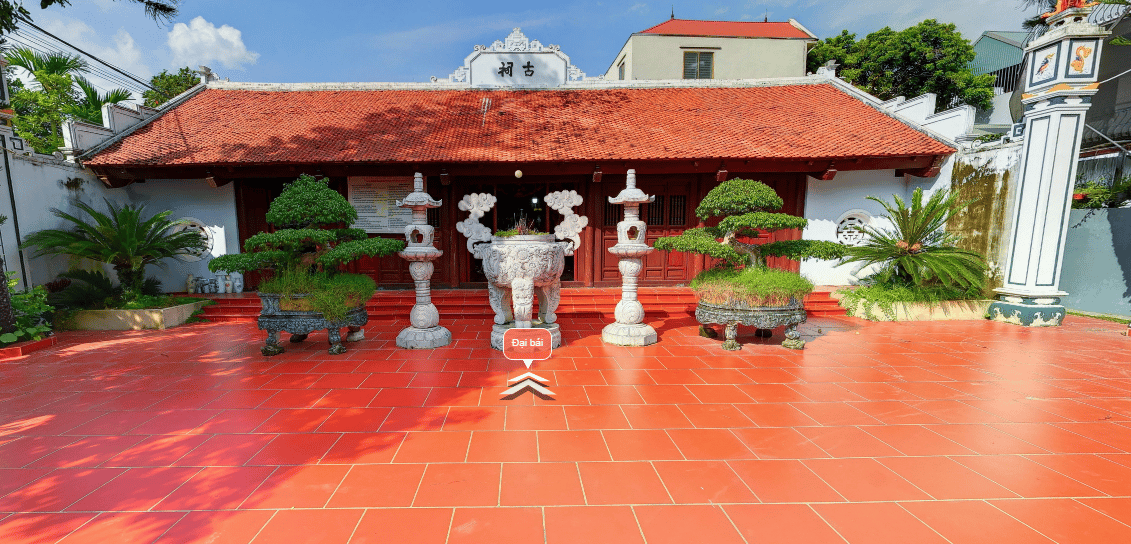
Cua Giang, then Co Giang, later called Co Duong. This land had an extremely important strategic position in our country's ancient history when Co Loa was chosen as the capital; Co Duong was a suburban area adjacent to and surrounding the citadel.
Co Duong Temple was built very early, with an area of about two Northern Vietnamese sao, on the foundation of an ancient shrine in the center of Co Duong Village, so it is also called Co Mieu. On the temple's architecture, some ancient carved panels remain; on the roof ridge, two characters Co Mieu are embossed.
Co Duong Temple worships three deities: Ban Canh Thanh Hoang Dai Gioi Linh Phu - Thien Bao Supreme Blessed Deity, the Earth God who secretly supported Ly Bon (Ly Bi) in his uprising to establish the Van Xuan state. When Ly Nam De ascended the throne, he granted him the title of deity and had Co Duong worship him. The deity legend also records that the Earth God Ban Canh Dai Gioi repeatedly secretly helped the country, and in later periods was bestowed with royal edicts by various dynasties.
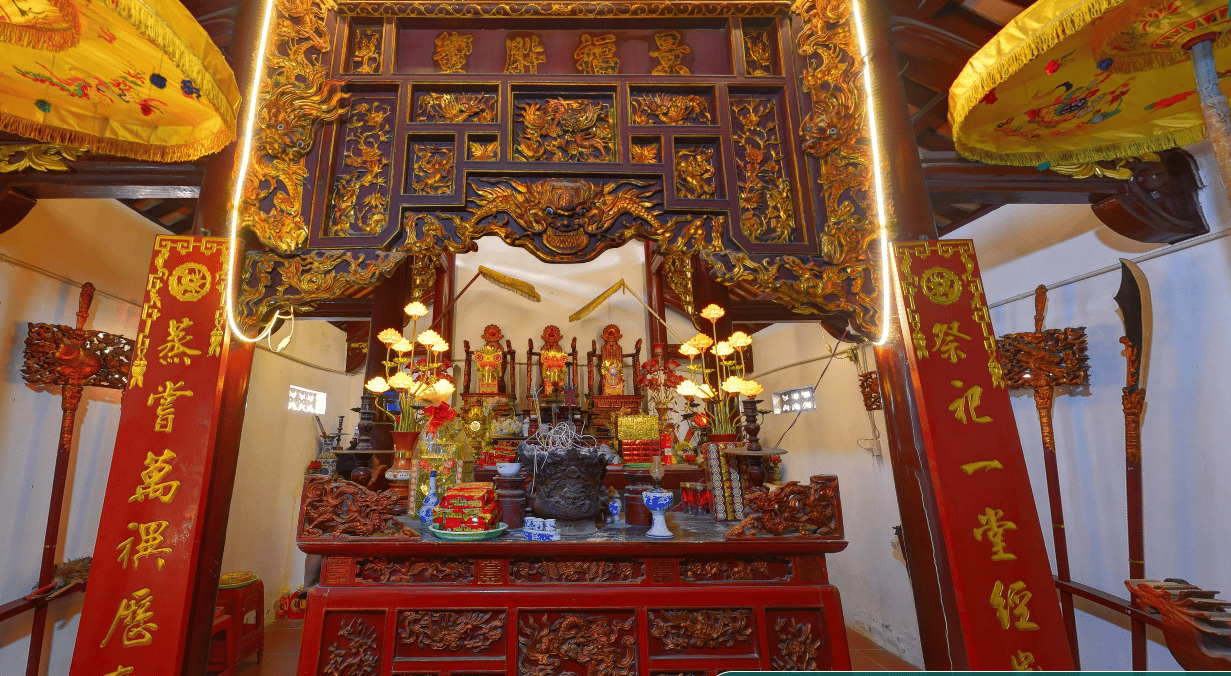
The second deity is King Ly Nam De, Xa Loi De Vuong, and the third deity jointly worshipped at the temple is Dong Vinh Dai Vuong, whose taboo name was Truong Hong, who had merit in helping the Hung King fight invaders.
The temple has a ding-shaped layout consisting of the main hall and the rear sanctuary. The seven-bay main hall is built in the style of a closed gable end with ngai-style arms and decorative pillars. The continuous system of folding doors gives the relic a solid and solemn appearance.
The rear sanctuary has three longitudinal bays, structurally attached behind the center of the main hall, built in the style of two-tiered overlapping roofs, with a tiger-face motif embossed at the gable end. The architecture features carvings of chrysanthemum leaves, flipped leaves, clouds, water waves, and bracket supports embossed with old chrysanthemums transformed into dragons... Overall, the decoration on Co Duong Temple's architecture is simple and strongly bears the artistic style of the early 20th-century Nguyen era. Nevertheless, the decorations help make the temple's architecture less constrained in form and create a sense of elegance.
The temple's ceremonial curtain is decorated in a distinctive Nguyen-era artistic style. Below the curtain, enclosing from the top of the rear main columns to each column shaft, there are individual altars. Outside the altars, ritual objects are displayed.
Co Duong Temple still preserves a set of precious artifacts: three dragon thrones and tablets decorated with dragon heads, tiger-face motifs, and four-season motifs dating from the Later Le period (18th century); a lacquered and gilded ceremonial curtain decorated with two dragons facing the sun, four sacred creatures, four-season motifs, and tiger-face motifs in the artistic style of the Nguyen period (19th century); a horizontal plaque with dragons flanking in relief; divine records copied in 1938 including 8 royal edicts dated: two edicts of Thieu Tri 6th (1846), Tu Duc 33rd (1880), Dong Khanh 2nd (1886), 2 edicts of Khai Dinh 2nd (1917), 2 edicts of Khai Dinh 9th (1924), and 1 volume of deity legends recording the deeds of the celestial deities worshipped at the temple, currently kept at the Institute of Social Sciences Information.
During the August Revolution, because the temple occupied a central position, it was used as a gathering place for the masses to participate in the uprising to seize power and as a meeting place for national salvation mass organizations. In the 1946-1954 period, the temple hosted the Gold Week, the election of the first National Assembly, and popular education classes. For a time, the temple was the headquarters of the Dong Anh District Administrative Committee (now Dong Anh Commune) and a base for Company 476 (Dong Anh District local troops) and the Phuc Yen Provincial Military Command to come and operate.
In 1947, when the village communal house was partially dismantled for scorched-earth resistance, the ritual objects were moved into the temple. In 1949, the village communal house was again burned and destroyed by enemy forces to take its wood and bricks to build a blockhouse, so all activities of worshipping the deity and the Village Guardian Spirit were moved to the temple.
During the resistance war against the Americans, the temple was used as the village headquarters; for many consecutive years, people's conferences were held here, and it served as the headquarters of the agricultural cooperative.
Previously, when the communal house still existed, a large festival was held, with a joyful local procession: the dragon palanquin, tablet, and eight-legged palanquin along with many ceremonial objects, flags, and offerings went from the temple to the communal house. Every few years, the festival was held in a year of good harvest and favorable weather. The festival at Co Duong welcomed people from all directions, neighboring villages, and descendants from various places... During the festival in Co Duong, offerings of round glutinous rice cakes, square glutinous rice cakes, and glutinous rice were made along with sacrificial rites, games, and singing.
Co Duong Temple (Shrine) was ranked as a City-level historical and architectural-artistic relic under Decision No. 9085/QD-UBND dated December 31, 2002.
More Other places
- Other placesVerified
Gioi Duc Pagoda (Hong An Temple)
Ung Hoa Commune
5.0Free  Other placesVerified
Hai Giac Pagoda
O Dien Commune
5.0Free Other placesVerified
Phuong Bang Pagoda (Hung Long)
Son Dong Commune
5.0Free Other placesVerified
Sung An Pagoda, also known as Sung Khang Pagoda (Dong Ba Pagoda)
Thượng Cát Ward
5.0Free
