
Church and tomb of the eminent physician Nguyen Dao An
Introduction
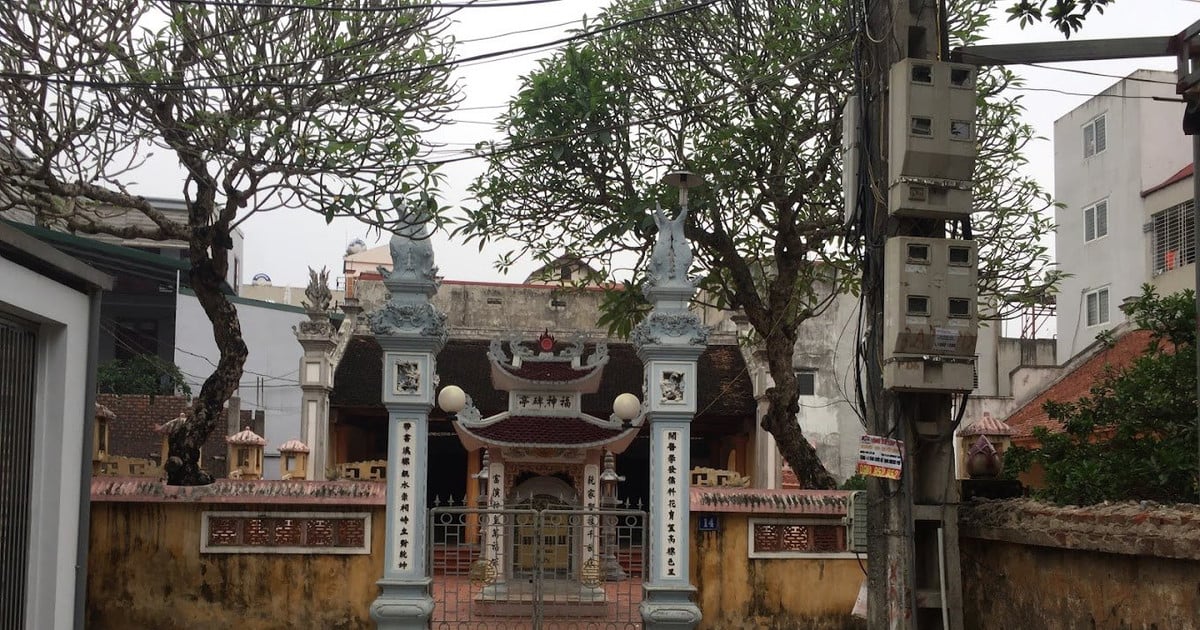
EMINENT PHYSICIAN - NATIONAL PRECEPTOR NGUYEN DAO AN AND THE HISTORICAL RELIC 'DAI VUONG TU'
The ancient land of Phu Dien (Phu Dien Ward, Hanoi) has long been famous not only for its renowned Phu Dien pomelos and glorious scholarly tradition, but also as a place preserving distinctive historical and cultural values. Among the notable figures who brought honor to their homeland, Eminent Physician and National Preceptor Nguyen Dao An (1591–1664) is an outstanding symbol of both medical talent and moral integrity in official life.
The relic site of the church ('Dai Vuong Tu') and the tomb of the notable figure Nguyen Dao An is today a valuable heritage destination, honoring a notable figure of the Le–Trinh era who devoted his entire life to serving the country, developing national medicine, and dedicating himself wholeheartedly to the people.
The relic site of the church and tomb of the notable figure Nguyen Dao An is located in Phu Dien village (Phu Dien Ward, Hanoi). It lies about 15 km west of the capital's center.
The notable figure Nguyen Dao An (personal name Thu Kinh) was born in 1591 and died in 1664 (aged 73). From childhood he was exceptionally intelligent and passed the Sinh do (Tu tai) examination in 1612. Later, he taught at the home of a Chinese physician who sold Northern medicines in the capital Hanoi. Thanks to his sharp intellect and passion for medicine, he fully absorbed and inherited traditional medical knowledge and became a renowned physician throughout the capital region.
His medical career reached its peak when Crown Prince Trinh Tac (son of Thanh Do Vuong Trinh Tung) suffered from a very serious eye disease, and the imperial physicians of the Imperial Medical Institute and renowned physicians from everywhere were helpless. When invited to treat him, with keen medical thinking and root-cause diagnosis (identifying it as accumulated heat with liver fire rising), he used only two medicines, rhubarb and licorice, for several months and completely cured the Crown Prince.
In recognition of this merit, Lord Trinh bestowed upon him a couplet of praise:
'A single pellet of elixir supports the Holy Lord
For ten thousand years, sacrifices endure before heaven and earth'
(Meaning: One dose of good medicine sustains the Holy Lord / For ten thousand years, fragrance lingers over the rivers and mountains.)
After the miraculous healing achievement, Nguyen Dao An was invited to stay at court to serve the dynasty, serving as a teacher and lecturer for the Le princes and the Trinh lord's crown prince, while also overseeing work at the Imperial Medical Institute.
Through successive reigns, he held many key positions in turn and reached the pinnacle of glory:
· Appointed Minister of Public Works, National Preceptor, with the title of Phai Quan Cong.
· When he died (1664), he was posthumously conferred the title of Thieu Bao by Kings Le Huyen Tong and Le Hy Tong and granted the posthumous title Cuong Chinh Dai Vuong.
Although he held high rank at court, Nguyen Dao An always upheld the spirit of national medicine with the idea 'Southern medicine treats Southern people.' He did not pass down Northern prescriptions but focused on researching and using domestic medicinal materials, recording many valuable family remedies for posterity.
In old age, he requested retirement (zhi si) in his native Phu Dien. Although retired, he still daily dispensed medicine and treated people to help the villagers without accepting a single coin in payment.
Legend says that when he was seriously ill, Lord Trinh Tac personally came to the village to visit his teacher. Seeing that the road into the village was too narrow, the Lord ordered soldiers and people to urgently widen it. In just a short time 'the time it took to chew a wad of betel', the nearly 1 km long road was completed. Since then, the people respectfully called it Dap Ba Trau Road – a mark commemorating the deep bond between the court and the eminent physician of Phu Dien.
After Nguyen Dao An passed away, in the fifth year of Vinh Tri (1680), the court had a shrine built to worship him in Phu Dien, with the Sino-Vietnamese name 'Dai Vuong Tu' (Dai Vuong Temple), and appointed officials to conduct annual sacrifices on his death anniversary.
The Nguyen Dao An temple is small and graceful, harmonizing with the traditional Northern Vietnamese village space:
· Temple gate & brick courtyard: The temple gate consists of two pillars leading into a quiet square brick courtyard.
· Tien te building: Consists of 3 bays built in the walled gable style, with a thuong chong ruong gia chieng, ha ke truss structure. The surfaces of the trusses and purlins are exquisitely carved with cloud patterns, plant patterns, and four-petaled lime flowers in bold relief and openwork carving.
· Hau cung: Designed with four roofs and softly curved corners, covered with fish-scale tiles. The ridge is decorated in relief with a fire sun above a tiger emblem. Inside the Hau cung are high brick platforms holding the dragon throne, memorial tablets, and incense table worshiping the notable figure.
· Ancient tomb area: Located in the middle of Phu Dien field, the tomb is built as a high earthen mound surrounded by a solid brick wall, on which is mounted an ancient stone stele bearing five Chinese characters: 'Nguyen Dai Vuong ancestral tomb'.
The Nguyen Dao An temple still preserves many historical relics of high scientific and artistic value:
· 2 ancient Le dynasty investiture edicts (17th century):
o Investiture edict of the first year of Van Khanh (1662): A rare surviving Le dynasty document conferring titles.
o Investiture edict of the fourth year of Chinh Hoa (1683): Praising him as 'A towering figure in the scholarly arena, with brilliant and great moral achievements, whose fame is engraved on tripods and bells'.
· A system of 3 dragon thrones, altars carved with dragon and four sacred creatures, incense tables, writing tables, bronze censers, and ceramic incense bowls from the 18th–19th centuries.
The relic site of the Nguyen Dao An church and tomb carries many special heritage values:
1. Historical–Medical value: On par with great physicians of the nation such as Tue Tinh and Hai Thuong Lan Ong Le Huu Trac, Nguyen Dao An is a typical figure representing the spirit of medical ethics, diagnostic talent, and the thinking of using Southern medicine to treat disease.
2. Cultural value - Gratitude: The royal court and the people establishing a temple, granting honors, and maintaining rituals for over 300 years demonstrates the tradition of 'When drinking water, remember its source' and honors talented individuals who contributed to the country.
3. Medical ethics lessons for the future: The relic site is a red address for educating younger generations and today's doctors and nurses about the spirit of diligent learning, integrity, dedication, and the belief that 'A physician is like a kind mother'.
The temple and tomb of the notable Nguyễn Đạo An are not only the pride of the people of Phú Diễn but also a precious cultural and historical heritage of the capital Hanoi.
Over more than three centuries with many historical vicissitudes, the serene and ancient space here has always shone with the example of a National Teacher - a talented and virtuous renowned physician who devoted his entire life to the country and the people.



