
Quan Dun
Introduction
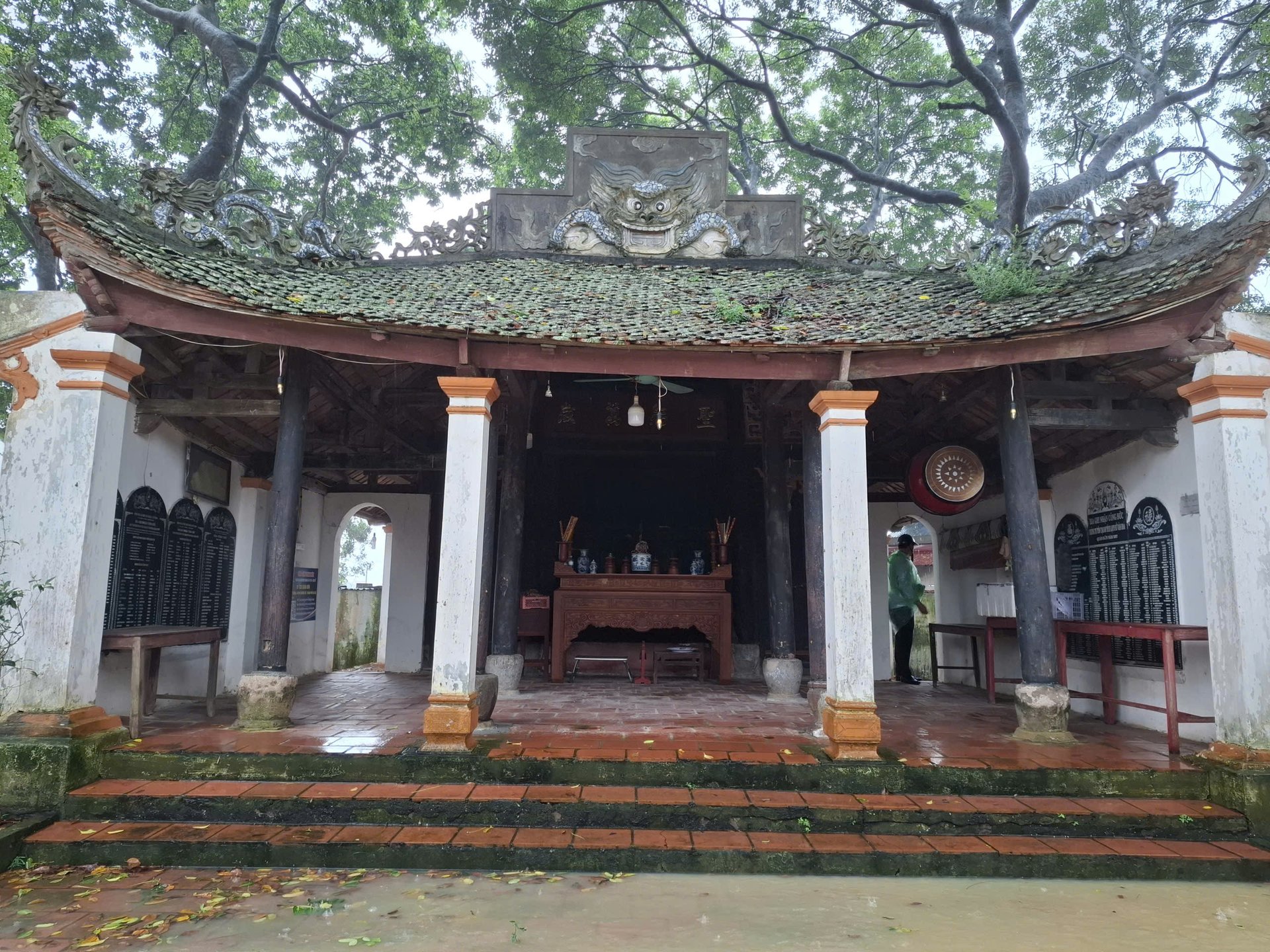
Quan Dun is located on the right bank of the Bui River, on a high mound in Liem Khe Village; locals often call it Dun Hamlet, hence the temple's name Quan Dun. It faces north, with the Bui River in front and fields on the other sides. Quan Dun is a relic founded in or before the Le Dynasty and is a place that maintains the worship of General Le Ngan, who rendered service to the country and the village during the Le Dynasty, was revered by the people, and was granted royal edicts by many generations of kings. Today, Quan Dun with its existing architectural items contributes to preserving and promoting traditional cultural values. The temple includes the following items: the Nghi Mon (gate), the Binh Phong (screen), and the worship hall, with a front hall and rear sanctuary layout, forming a solemn architectural complex. The load-bearing wooden components of the architectural items mainly favor the solidity of the structure, interspersed with decorative carved panels so that they not only serve as connecting elements but also as a means of conveying the people's aspirations.
At present, Quan Dun still preserves valuable artifacts such as: a system of royal edicts dating from the Le to the Nguyen Dynasty, a Tho Ha ceramic incense burner - 18th-century art, and a Nguyen Dynasty long ngai and tablet. Overall, the architecture of Quan Dun remains fairly good. The Nghi Mon is designed with four pillars, including two large pillars and two small pillars. The large pillars are built in the traditional style: topped with a kneeling nghe image, lantern compartments embossed with the four sacred creatures, and the body inscribed with parallel sentences. The small pillars have tops shaped like a nail head, and their bodies are similar to the large pillars but without inscriptions. Connecting the large and small pillars are low walls embossed with images of war elephants. Passing through the Nghi Mon and a courtyard leads to the relic; in front of the temple is a screen in the form of a scroll and a wall connecting to small pillars. The temple has a front hall and rear sanctuary layout with two spaces: the front worship hall and the rear sanctuary. The wooden structure of the front worship hall is mainly smooth-planed and tightly joined, favoring durability, with decorative patterns concentrated in the inner bay's truss frame (in front of the forbidden sanctuary). Here the panels are carved quite meticulously with traditional decorative themes such as: two dragons facing the moon, hook-shaped clouds, and leaf dragons. Rising behind the center of the front worship hall is the rear sanctuary; this is a sacred space arranged with many worship objects of the relic, with three sides enclosed by laterite walls in the closed-gable style. The components are smooth-planed and tightly joined, favoring the durability of the structure.
On February 21, 2018, the People's Committee of Hanoi City issued Decision No. 839/QD-UBND ranking the Quan Dun relic, in Tot Dong Commune, Chuong My District, Hanoi City, as a provincial/municipal-level historical relic.



