
Phuong Tri Quan
Story
01INTRODUCTION TO PHUONG TRI QUAN - DAN PHUONG COMMUNE
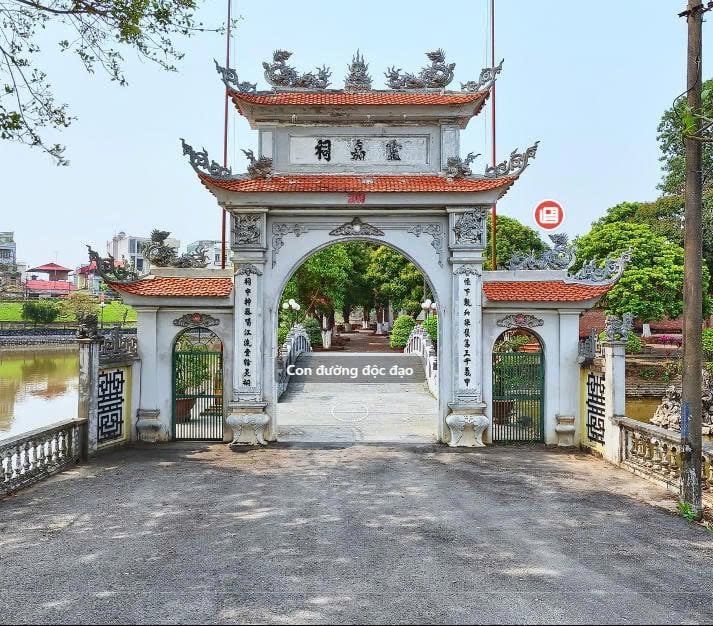
Phuong Tri Quan is located outside the dyke of Phuong Tri village, in Phung town, Dan Phuong district, Hanoi city before the reorganization (now Phuong Tri hamlet - Dan Phuong commune). Phuong Tri Quan belongs to Dan Son Four Quan including: Quan Gia (Duong Lieu – Hoai Duc); Quan Linh Tien, Quan Vien Duong (Duc Thuong – Hoai Duc) and Phuong Tri Quan (the place name Dan Son dates from the Tran dynasty and includes present-day Dan Phuong and Hoai Duc districts).
The temple grounds lie on a high mound, facing airy southeast; in front and on both sides are the dyke slope and vast water lagoons. The temple is like a peninsula reflected in the clear blue water. Legend has it that the temple was built very early, initially a small shrine. In the year Nham Tuat (1922), with the people's unanimous contributions, the small shrine was repaired into a temple with architectural appearance modeled after Bac Cung Temple (Vinh Phuc). Over time, with events and historical ups and downs, the temple deteriorated; in 2008, with approval from the Provincial People's Committee, the Ha Tay Provincial Department of Culture, Sports and Tourism, and the Dan Phuong District People's Committee, Phuong Tri Quan was restored and embellished spaciously and grandly.
The temple includes the Nghi Mon gate, bell tower and drum tower, left and right corridors, Tap Mon gate, Dai Bai hall and rear palace.
The Nghi Mon gate of Phuong Tri Quan is simply made with three walkways. In the center of the Nghi Mon are two pillar monuments, topped with four phoenixes facing each other, below is a lantern niche, on both sides are two small gates with two tiers and eight curved roofs, above are stylized finials.
The bell tower and drum tower are two four-roofed buildings of equal size, including four roofs with four soft and graceful curved corners. The architecture is mainly made of brick and tile, and the trusses are smoothly planed and fitted.
The two left and right corridors consist of 5 bays, built with closed gable walls and sloped ends; the trusses are made in the keo ke style with crossbeams; this is where guests are received and ritual offerings are prepared.
Most prominent in the temple grounds is Tap Mon with the Gothic architectural style of Catholicism. Tap Mon is built in 2 tiers with 3 walkways; the middle walkway has a pair of elephants in attendance and is decorated with a stylized tiger symbol. The upper tier has 5 empty arches; on both sides are two pillar monuments decorated with four phoenixes facing, dragon coils around water, two dragons facing the moon, and four Chinese characters Trac giang dinh chi to preserve the legend of General Dao Danh Mot.
Dai Bai hall of Phuong Tri Quan has a structure of 3 bays and 2 side bays, built with closed gable walls; the trusses are made in the upper cau dau and lower ke style on 4 rows of columns. The decoration of Dai Bai is mainly dragon and tiger symbols characteristic of the Nguyen era. In the center of Dai Bai is a platform and worship objects such as the truong sword, bat buu, and van gia. The two central columns hang a pair of parallel sentences from the Bao Dai era praising the merit of the deity; above is a horizontal plaque inscribed with four characters Tham Tan Hoa Duc.
The rear palace of the temple consists of 2 long bays; the trusses are made in the gia chieng chong ruong style. The decoration in the rear palace is shown on the corner brackets and niches with flying dragons. At the highest position is a worship platform and two long ngai and spirit tablets along with other worship objects. The truss of the rear palace is carved with two dragons facing the moon and four Chinese characters Thanh cung van tue.
Unlike other temples built to worship Lao Tzu, Phuong Tri Quan worships two human deities in Vietnamese folk belief: Tich Lich Hoa Quang and General Dao Danh Mot. This is a distinctive point of syncretism in Vietnamese folk culture.
Through the ups and downs of history, today the temple still preserves the pair of stone nghe from the Le era, 2 pairs of worship cranes, 2 Tho Ha ceramic incense burners, a curtain door, saint robes, sacrificial texts, and a number of other valuable ritual objects; although time has passed, this place remains the center of cultural and spiritual activities of the people of Phuong Tri. In 2006, the temple was ranked as a city-level historical and cultural relic under Decision No. 306 - QD/UBND dated February 22, 2006.



